Ethan was released the following year.
We learned through Margaret that he had found temporary work and was attending counseling.
He was living in a modest rented room.
He had begun making restitution payments.
He did not ask us for money.
For several months, he sent Linda a short letter every few weeks.
She answered when she felt ready.
Then, one afternoon, he asked whether he could visit.
Linda read his request twice.
She placed it on the table.
“What do you think?” she asked.
I considered the question carefully.
“I think it’s your decision.”
She shook her head.
“It’s our home.”
I looked at her.
“Then we decide together.”
We talked for three evenings.
Not about whether we loved him.
We did.
But about whether seeing him would reopen wounds Linda had only recently begun to heal.
Eventually, she said, “I want to know who he is now.”
So we agreed to meet him.
Not inside the house.
At the little park three blocks away.
Ethan arrived ten minutes early.
When we approached, he stood from the bench.
He looked thinner.
Older.
His hair was shorter, and the expensive watch he used to wear was gone.
For a moment, none of us spoke.
Then he looked at Linda.
“Hi, Mom.”
Her lips trembled.
“Hello, Ethan.”
He took one step forward.
Stopped.
“Can I hug you?”
Linda looked at him for a long moment.
Then she nodded.
He embraced her carefully.
As though he knew he no longer had the right to assume she’d welcome his touch.
She held him for several seconds.
Then stepped back.
We sat on the bench.
Ethan kept his hands clasped between his knees.
“I’ve practiced what I wanted to say,” he admitted.
Linda waited.
“But now that you’re here, it all sounds stupid.”
“Then don’t give us a speech,” I said.
He looked at me.
“Just tell us the truth.”
He lowered his head.
“I was jealous of you.”
I frowned.
“Of me?”
He nodded.
“You had everything figured out. The house. Your marriage. Your work. People respected you.”
I said nothing.
“I kept thinking I was supposed to have all of that by thirty.”
He rubbed his palms together.
“When the business failed, I couldn’t stand the thought of you seeing me as a failure.”
“So you decided to make us failures instead?” I asked.
He winced.
“Yes.”
The answer surprised me.
He did not argue.
Did not defend himself.
He simply accepted the ugliness of what he’d done.
Linda leaned forward.
“Ethan, when you locked me outside, did you really believe the house belonged to you?”
He looked at her.
“No.”
Her face changed.
He swallowed.
“I knew it didn’t. I just thought if I acted like it did, eventually you’d give in.”
Linda closed her eyes.
A tear slipped down her cheek.
Ethan began crying too.
“I’m sorry, Mom.”
She opened her eyes.
“I know.”
“Can you forgive me?”
She looked toward the playground, where a little girl was learning to climb a ladder while her father stood nearby.
“I don’t know how to answer that yet.”
Ethan nodded.
“I understand.”
“But I want you to keep becoming someone who would never do that again.”
He wiped his face.
“I will.”
I looked at him.
“Then start by building a life that doesn’t depend on what we own.”
He nodded again.
“I am trying.”
We sat together for another hour.
There were awkward silences.
There were difficult questions.
But there were also small moments that felt almost familiar.
Ethan asked about the garden.
Linda told him about the marigolds.
He smiled.
“Do you still have the roses?”
“Of course.”
He looked down.
“I remember helping you plant them.”
Linda nodded.
“You were six. You kept putting worms in your pockets.”
For the first time that afternoon, all three of us laughed.
It did not erase anything.
But it reminded us that the years before the betrayal had been real too.
When we parted, Ethan did not ask to come home.
He simply said, “Thank you for meeting me.”
I shook his hand.
Then, after a moment, I pulled him into a brief embrace.
I felt him stiffen with surprise.
“I’m proud of you for telling the truth today,” I said.
His shoulders shook.
“But there’s still work to do.”
“I know, Dad.”
We watched him walk toward the bus stop.
Linda slipped her hand into mine.
“Do you think he’ll be all right?”
“I don’t know.”
She nodded.
Neither of us needed to pretend certainty.
We walked home slowly.
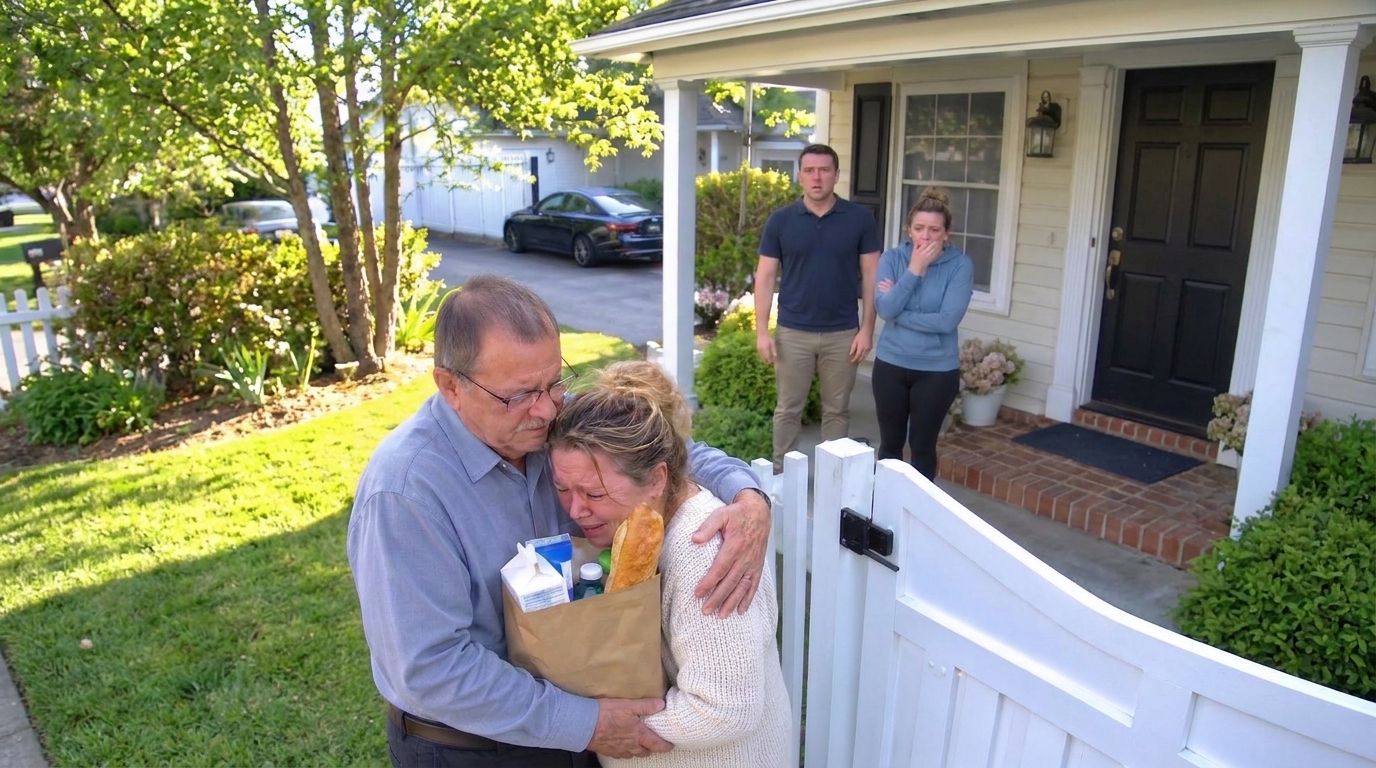
When we reached the gate, Linda stopped.
The roses were blooming.
The marigolds shone gold beneath the afternoon sun.
She took out her keys.
Then she looked at me.
“Do you remember what you said that night?”
I smiled faintly.
“Which part?”
“When you brought me back inside.”
I thought for a moment.
“Tonight, you’re going to listen?”
She shook her head.
“Before that.”
I remembered.
Then tonight, he finds out who truly owns this family.
I looked at her.
For a long moment, I had believed those words meant I would prove who owned the house.
Who held the deed.
Who controlled the money.
But standing there beside my wife, I understood something I hadn’t understood that evening.
Nobody owned our family.
Not Ethan.
Not Ashley.
Not even me.
Love was not ownership.
It was responsibility.
It was the freedom to stay, the courage to say no, and the willingness to protect someone’s dignity even when doing so was painful.
I turned toward Linda.
“I think I was wrong about something.”
She raised an eyebrow.
“Only one thing?”
I laughed.
She smiled.
“What was it?”
“I said I was going to show Ethan who owned this family.”
“And?”
I took her hand.
“Nobody does.”
She looked at me quietly.
Then her eyes filled with tears.
“Good,” she whispered.
She entered the code.
The gate clicked open.
We walked through together.
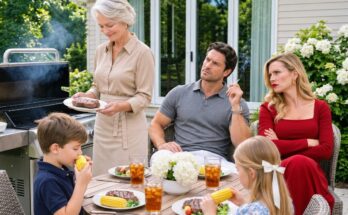
That evening, I grilled chicken in the backyard while Linda set two plates on the patio table.
The air was warm.
A breeze moved through the roses.
Somewhere down the street, children were riding bicycles.
Linda brought out a pitcher of lemonade and sat beside me.
We ate slowly.
Talked about ordinary things.
A loose gutter.
A neighbor’s new puppy.
Whether we should take a trip to the coast in September.
Then Linda reached across the table.
“Tom?”
“Yes?”
“Do you ever wish we’d sold the house years ago?”
I looked around.
At the patio I’d built with my own hands.
At the windows Linda had decorated.
At the garden she’d kept alive through every difficult season.
At the woman sitting across from me.
“No.”
She smiled.
“Neither do I.”
As the sun disappeared, the porch light came on automatically.
I remembered installing the first light beside our front door more than thirty years earlier.
Linda had been standing in the yard holding a tiny Ethan in her arms.
She’d laughed because I kept adjusting the angle.
“Why does it matter so much?” she’d asked.
And I’d answered, “Because I want you to be able to find your way home in the dark.”
I had forgotten that conversation until that moment.
Now, watching the light spread across the walkway, I realized it had always been the truest promise I’d made her.
Not that life would be easy.
Not that our son would never disappoint us.
Not that the house would always be full.
Only that when darkness came, she would have somewhere safe to return.
Linda followed my gaze.
“What are you thinking about?”
I reached for her hand.
“The porch light.”
She looked toward it and smiled.
“You still haven’t fixed the crooked bracket.”
I laughed.
“All these years, and that’s what you notice?”
“All these years,” she replied, “and you’re still promising to fix it.”
We laughed together.
Then she leaned against my shoulder.
And for a long while, we watched the light shine over the open path.
The house was quiet.
The doors were secure.
The roses were blooming.
And the woman I loved was exactly where she belonged.
Home.
Not because anyone had given her permission.
Not because her name appeared on a document.
But because she had built a life here with her own hands, her own sacrifices, and her own extraordinary heart.
I kissed the top of her head.
“Linda?”
“Hmm?”
“You’ll always have a place beside me.”
She lifted her face.
“I know, Tom.”
Then she smiled that familiar smile I’d fallen in love with more than four decades earlier.
“And you’ll always have a place beside me.”
The porch light glowed.
The evening settled softly around us.
And for the first time in a very long time, neither of us was waiting for the other shoe to drop.
We were simply living.
Together.
In the home we had chosen.
In the peace we had fought to protect.
And that, I finally understood, was the inheritance that mattered most.