In October, Margaret called with news.
Our updated estate documents were ready.
Linda and I had spent weeks discussing what to do.
We had no intention of disinheriting Ethan out of revenge.
But we were no longer willing to make our home the prize at the end of his waiting.
We established arrangements protecting our right to live in the house for the rest of our lives and directing most of its eventual value toward a charitable fund supporting older adults facing housing insecurity and financial exploitation.
We also reserved a modest amount for Ethan, conditional on lawful administration rather than his control over our property.
Margaret reviewed everything carefully.
When she finished, she looked at us.
“Are you both comfortable with this?”
Linda answered before I could.
“Yes.”
I turned toward her.
She smiled faintly.
“This house has protected us for almost forty years,” she said. “Maybe one day it can protect someone else.”
Margaret nodded.
Then she slid one final document toward me.
It was an old letter.
My handwriting.
I recognized it immediately.
“What is this?”
Margaret smiled.
“You gave this to my predecessor when you first completed your estate planning. You asked that it be kept with your records.”
I opened the envelope.
The paper had yellowed.
Across the top was a date from when Ethan had been five.
I began reading.
It was a letter I’d written after nearly losing my job during a factory closure.
At the time, we had been terrified of losing the house.
I had written about Linda working extra shifts, about our neighbors bringing meals, and about the promise I’d made to myself when we finally caught up on our mortgage payments.
I read the last paragraph aloud.
“If we are fortunate enough to keep this home, I hope we never forget that its greatest value is not what someone would pay for it. Its value is that nobody inside it should ever have to wonder whether they belong.”
Linda covered her mouth.
I stopped reading.
For several seconds, neither of us spoke.
Then she whispered, “You wrote that?”
I nodded.
“I’d forgotten.”
She took the letter.
Read it again.
And began to laugh through her tears.
“Tom, do you remember why we nearly lost the house?”
“Of course.”
“The factory closure?”
I nodded.
She shook her head gently.
“That wasn’t the whole reason.”
I looked at her.
“What do you mean?”
She folded the letter carefully.
“Do you remember the winter Ethan was sick?”
He had been five, hospitalized with a severe infection.
We had spent nearly two weeks terrified that we might lose him.
“Yes.”
Linda’s voice softened.
“We used part of the mortgage money for the medical bills. You never complained. You just worked more hours.”
I stared at her.
She continued.
“You kept saying we’d rebuild our savings because the only thing that mattered was bringing our boy home.”
The room blurred.
For years, I had remembered that period as a financial struggle.
Linda remembered it as the winter we had almost lost our child.
And suddenly, the entire story of our house changed.
We had not built it merely to leave Ethan something.
We had nearly lost it trying to keep him alive.
I lowered my head.
Linda reached across the table.
“Tom, don’t.”
“I don’t know where we went wrong.”
She held my hand.
“We loved him. That wasn’t wrong.”
“But we taught him—”
“We taught him what we could. He’s responsible for what he chose to do with it.”
I looked at the letter again.
Its words seemed different now.
Nobody inside it should ever have to wonder whether they belong.
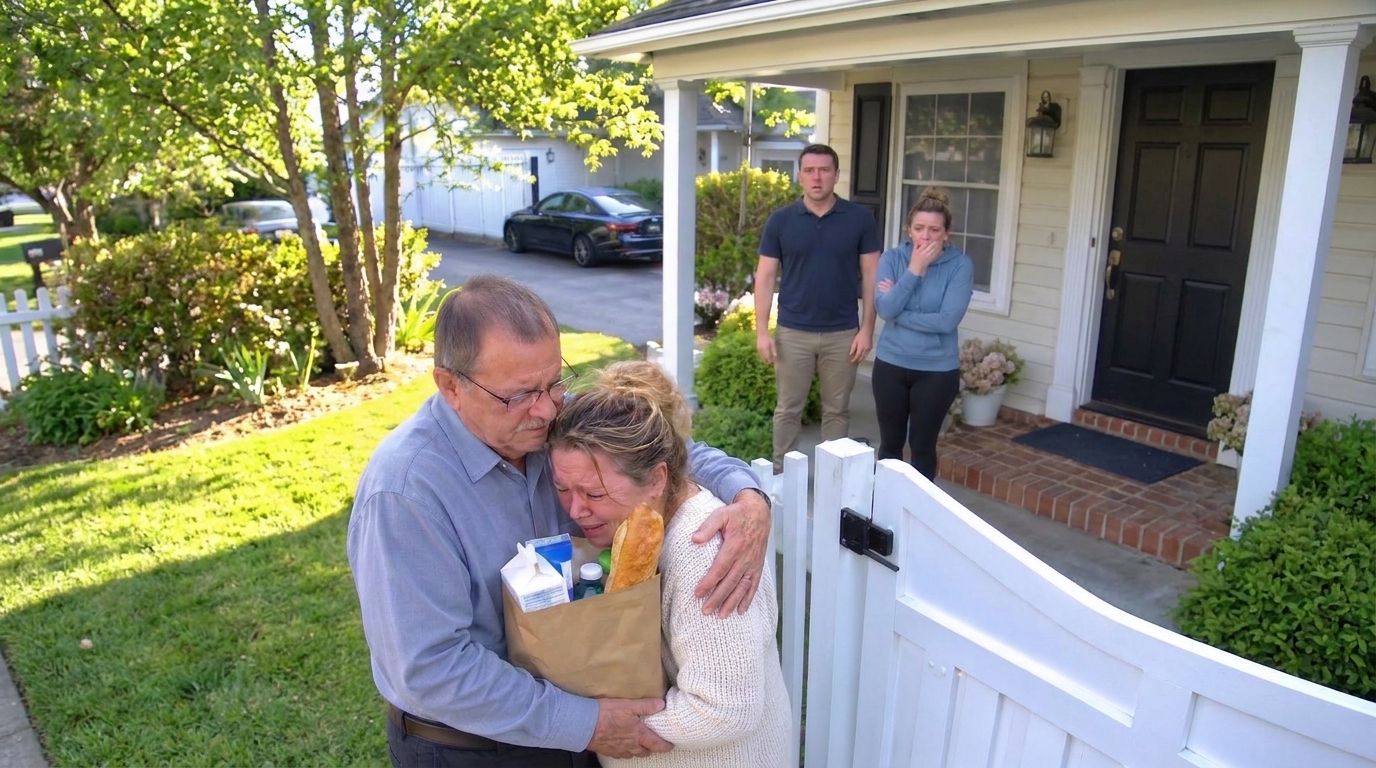
I thought of Linda standing outside the gate.
And I understood why that moment had wounded me so deeply.
Ethan had taken the one promise this house was built upon and turned it upside down.
That winter, we received a letter from prison.
It was from Ethan.
Unlike his earlier messages, it contained no excuses.
He described the moment he’d changed the gate code.
He admitted that Linda had asked him three times to reconsider.
He wrote that he had watched her walk down the path carrying her groceries.
And he had done nothing.
Linda stopped reading.
Her hands were trembling.
I waited.
Then she continued.
Ethan wrote about the business, the debts, and the lies he’d told himself.
He admitted that he had begun treating our future deaths as a financial event rather than a loss.
He described the shame of hearing his mother’s voice in court.
And at the bottom, he wrote:
“I don’t expect you to forgive me. I don’t expect the house. I don’t even expect you to visit. But I need you to know that the worst thing I did wasn’t signing Dad’s name. It was making Mom feel unwanted in the place where she spent her life making me feel safe.”
Linda read that sentence twice.
Then she folded the letter.
For a long time, she sat without speaking.
Finally, she said, “That’s the first time he’s understood.”
“Do you want to answer?”
She looked toward the window.
“Not yet.”
I nodded.
And for the first time in our marriage, I did not try to solve the pain she was carrying.
I simply sat beside her.
Three weeks later, Linda wrote back.
She spent an entire afternoon at the kitchen table.
Sometimes she wrote.
Sometimes she crossed out whole paragraphs.
When she finished, she handed me the letter.
It was only one page.
She told Ethan she loved him.
She told him she was glad he had finally taken responsibility.
She told him that forgiveness would take time and that trust would require more than words.
And she ended with a sentence I will remember for the rest of my life.
“You will always be my son, but being my son does not give you the right to make me small.”
I read it and handed it back.
“It’s perfect.”
She shook her head.
“No. It’s true.”
She mailed it the following morning.
We did not receive an immediate reply.
And strangely, that was all right.
The following spring, Linda turned sixty-three.
I planned a small birthday dinner.
Mrs. Peterson came over with peach cobbler. Linda’s sister drove in from out of town. Two old friends from our church brought flowers.
We ate in the dining room beneath the light fixture I’d installed twenty years earlier.
There was laughter.
There were stories.
There was a terrible joke about my cooking that Linda insisted on telling twice.
At one point, I looked around the table and realized something.
For years, we had believed family meant keeping everyone together at any cost.
But the people sitting in our home that evening were there because they wanted to celebrate Linda.
Nobody was calculating the value of the furniture.
Nobody was discussing inheritance.
Nobody was waiting for us to disappear.
They were simply glad she was alive.
After everyone left, Linda and I carried the dishes into the kitchen.
She was humming.
I hadn’t heard her hum while washing dishes since before the day Ethan locked her out.
I stood in the doorway listening.
She noticed me.
“What?”
“Nothing.”
She narrowed her eyes.
“Tom Harris, you’re staring.”
I smiled.
“I like hearing you sing.”
“I wasn’t singing.”
“You were close enough.”
She laughed.
Then she put down the dish towel and walked into my arms.
We stood there while the dishwasher ran.
Her head rested against my chest.
“I’m happy,” she whispered.
The words were so simple that they nearly undid me.
I kissed her forehead.
“So am I.”