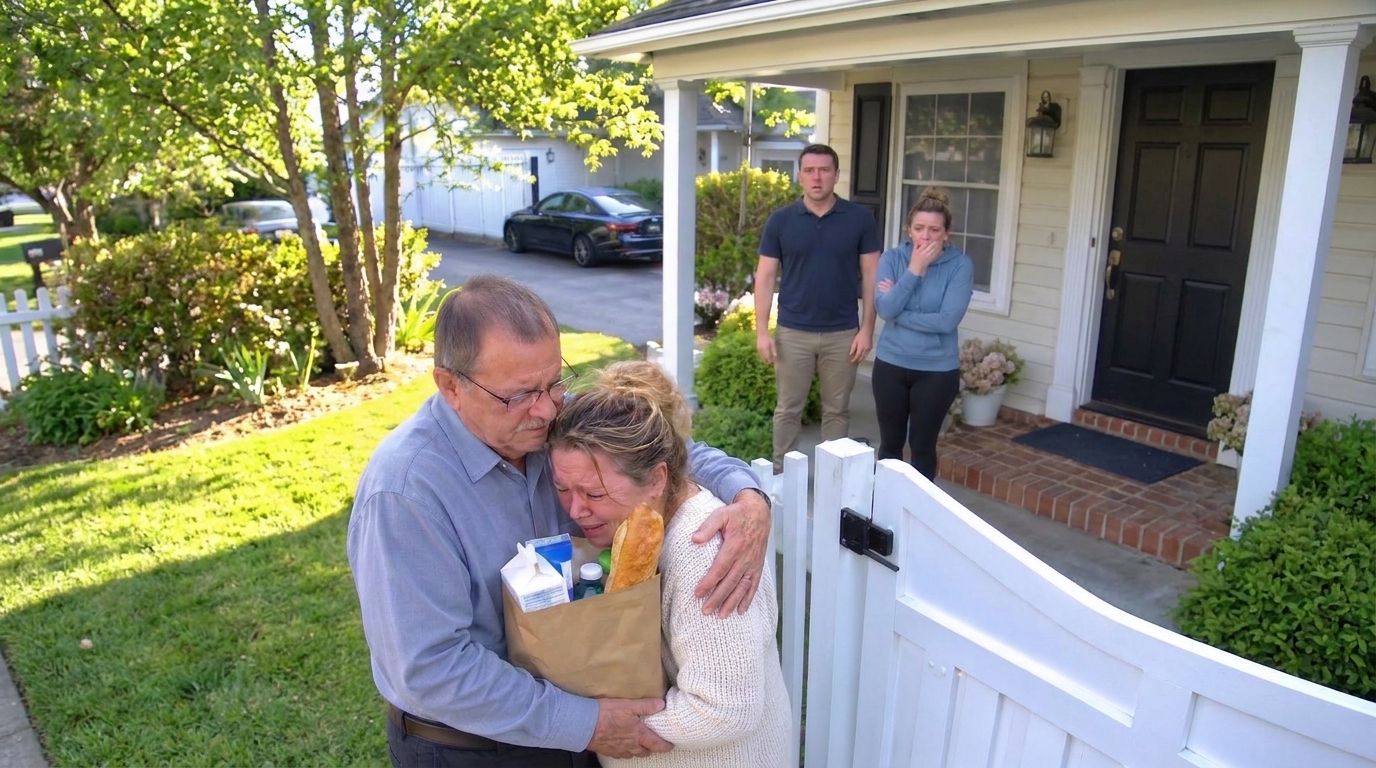
That night, neither of us slept.
At seven the next morning, I called our attorney, Margaret Ellis.
Margaret had handled the final paperwork when we paid off our mortgage. She was practical, sharp, and not easily impressed.
When I explained what had happened, she interrupted me.
“Tom, do not confront Ethan again until we’ve checked the records.”
“Why?”
“Because if he’s attempted something fraudulent, we need to preserve the evidence before he realizes what we know.”
At nine, Linda and I entered the bank.
The branch manager, a woman named Patricia Wells, led us into a private office.
She had known us for nearly fifteen years.
That morning, she looked uncomfortable.
“Mr. and Mrs. Harris, I need to ask whether either of you authorized your son to act on your behalf regarding the property.”
“No,” I said.
Patricia glanced at Linda.
“Mrs. Harris?”
Linda shook her head.
“No.”
Patricia opened a folder.
“An application was submitted through a third-party lending service using information associated with your property. It listed Ethan Harris as an authorized representative.”
My wife gripped my arm.
“Authorized by whom?” I asked.
Patricia slid a photocopy across the desk.
At the bottom was my name.
Thomas Harris.
Written in a signature that looked almost like mine.
Almost.
I had spent forty years signing repair invoices, purchase orders, and payroll forms.
I knew every curve of my own handwriting.
“That isn’t my signature.”
Patricia nodded slowly.
“We had concerns about the verification documents. That’s why the application was flagged.”
I looked at the date.
Three weeks earlier.
While Linda and I had been visiting her sister.
The room seemed to tilt.
“How much?” I asked.
Patricia hesitated.
“The proposed loan amount was two hundred and eighty thousand dollars.”
Linda whispered my name.
I barely heard her.
Two hundred and eighty thousand dollars.
Against the home we’d spent most of our marriage paying for.
Margaret arrived twenty minutes later.
She examined the documents without speaking.
Then she looked at Patricia.
“Has any money been disbursed?”
“No. The transaction was placed on hold.”
For the first time that morning, I could breathe.
But Margaret wasn’t finished.
“We also need to check the county property records and determine whether any other instruments have been submitted.”
She turned toward me.
“Tom, there’s something else you should know. Your son called my office last week.”
I stared at her.
“What did he want?”
“He asked how quickly a house could be transferred into a child’s name if the parents were becoming mentally incapable of managing their affairs.”
Linda made a sound I will never forget.
It was small.
Almost a gasp.
But it carried thirty-two years of motherhood inside it.
Margaret looked at her gently.
“I refused to discuss your private affairs with him.”
I stood and walked toward the window.
Outside, people were crossing the parking lot carrying coffee cups and briefcases.
The world was continuing normally.
Mine had stopped.
My son hadn’t merely tried to take my house.
He had been preparing to take away our right to decide what happened to it.
When we returned home, there was a message waiting on the answering machine.
Ethan.
“Dad, Ashley and I are willing to forget last night if you agree to meet us. But we need to finalize things before Friday. Please don’t make this harder than it needs to be.”
Friday.
It was Wednesday.
I played the message again.
Then I called Margaret.
She listened carefully.
“Ask him to meet you tomorrow,” she said. “At my office. Tell him we’ll discuss the property.”
“You want me to pretend I’m considering it?”
“I want him to explain his intentions in a setting where everyone understands what’s being said.”
I looked at Linda.
She was standing beside the kitchen window, staring at the gate.
“I’ll ask her,” I told Margaret.
Because this was no longer just my decision.
When I explained the plan, Linda remained quiet.
Then she said, “I want to be there.”
“Are you sure?”
She nodded.
“He told me I didn’t understand anything.”
Her voice trembled.
“I want him to look at me when he says it again.”
The next morning, Ethan and Ashley arrived at Margaret’s office dressed as though they were attending a business meeting.
Ethan wore a navy jacket I had bought him for his first job interview.
Ashley carried a leather folder.
Neither hugged Linda.
Ethan sat across from us.
“I’m glad you’re finally being reasonable.”
Margaret folded her hands.
“Mr. Harris, your parents have asked me to clarify your proposal.”
Ashley immediately opened her folder.
“We’ve found a buyer interested in the property. The market is strong, and the house needs updating. It makes sense to sell before maintenance costs become unreasonable.”
I stared at her.
“And where would we live?”
Ethan answered.
“We found a senior community about forty minutes away.”
Linda went very still.
“A senior community?”
“It’s actually nice, Mom.”
“Have you seen it?”
“Online.”
She nodded slowly.
“Of course.”
Margaret leaned forward.
“Did your parents authorize you to list their home?”
Ashley hesitated.
“We were preparing the process.”
“Did they authorize you to obtain financing against it?”
Ethan’s expression changed.
“What financing?”
Margaret placed a copy of the application on the table.
The color drained from his face.
Ashley stopped moving.
I watched my son’s eyes travel toward the signature.
Then toward me.
“Dad, I can explain.”
“Please do.”
He swallowed.
“It was only preliminary.”
“You signed my name.”
“I was trying to keep things moving.”
“You forged my signature.”
Ashley leaned forward.
“We didn’t take any money.”
Margaret looked at her.
“That does not make an unauthorized application harmless.”
Ethan’s voice rose.
“You don’t understand! We had deadlines!”
I leaned back.
“What deadlines?”
He looked at Ashley.
She stared at the table.
“Ethan,” I said quietly, “what deadlines?”
He dragged both hands over his face.
Then he told us.
Their business had failed.
Not the successful consulting business they had described at Christmas.
Not the thriving company Ashley had posted photographs about.
A business drowning in debt.
They owed suppliers, lenders, and private investors more than one hundred and ninety thousand dollars.
Their expensive apartment was three months behind on rent.
Their car was financed.
Their credit cards were nearly exhausted.
And a lender had demanded repayment by Friday.
Linda pressed her fingers against her lips.
“Why didn’t you tell us?”
Ethan laughed bitterly.
“Because Dad would have given me another lecture about responsibility.”
I felt something inside me fracture.
“Ethan, when you were twenty-six and lost your job, who paid your rent for six months?”
He looked away.
“When your car broke down, who bought you another one?”
Silence.
“When you wanted to start your business, who gave you twenty thousand dollars?”
His eyes filled with anger.
“You always bring up everything you’ve done for me!”
“Because you’re standing here claiming I never helped.”
Ashley suddenly pushed her chair back.
“This is pointless.”
Margaret’s voice remained calm.
“Mrs. Harris, please sit down.”
Ashley looked at her husband.
“Tell them.”
Ethan froze.
“Ashley.”
“Tell them why we need the money.”
His face turned pale.
I felt Linda’s hand find mine beneath the table.
“What haven’t you told us?” I asked.
Ashley opened her folder again.
This time, she removed a document bearing Linda’s name.
My wife stared at it.
“What is that?”
Ashley said nothing.
Margaret took the paper.
Her expression hardened.
It was a draft statement alleging that Linda was experiencing significant cognitive decline and could no longer make reliable financial decisions.
The statement included fabricated examples of confusion and memory loss.
One paragraph described her heart medication as evidence that she was unable to manage daily life independently.
Linda stared at the page.
Then she looked at Ethan.
“You wrote this?”
He didn’t answer.
“Ethan.”
His shoulders dropped.
“It wasn’t supposed to hurt you.”
She slowly withdrew her hand from mine.
“You told someone I couldn’t think for myself?”
“We needed to establish that Dad was being influenced—”
“By me?”
His mouth opened.
Nothing came out.
Linda stood.
For a moment, I thought she might collapse.
I reached toward her, but she gently moved away.
She walked around the table until she stood directly in front of our son.
“I carried you for nine months,” she said.
Her voice was almost inaudible.
“I sat beside your bed when you had pneumonia. I drove through a snowstorm because you were frightened at college. I kept every birthday card you ever gave me.”
Ethan’s eyes glistened.
“Mom—”
“And yesterday, you put me outside my own home.”
He looked down.
She waited.
“Look at me.”
He raised his head.
“You didn’t just want the house,” she whispered. “You wanted people to believe I wasn’t capable of saying no.”
No one spoke.
Then Linda did something that surprised us all.
She took the paper from Margaret.
Folded it once.
Placed it in front of Ethan.
“You can lose money and still be my son,” she said. “You can fail and still be my son. But you cannot destroy my dignity and ask me to pretend it was love.”
Ethan began to cry.
Not loudly.
His face simply crumpled.
Ashley stood.
“Oh, for heaven’s sake. We don’t have time for this.”
Everyone turned toward her.
She looked at Ethan with undisguised disgust.
“Your parents have a house worth more than half a million dollars, and they’re sitting here acting like we’re criminals because we tried to use a fraction of it.”
Margaret’s expression became cold.
“Attempting to obtain a loan using a forged signature is a serious matter.”
Ashley waved a hand.
“Then prove who signed it.”
The room went silent.
Ethan looked at her.
“Ashley, stop.”
She ignored him.
“You can’t prove anything.”
Margaret opened another folder.
“Actually, the lender preserved the submission records, including the account used to upload the documents. The application also contains a verification photograph.”
Ashley froze.
Margaret turned the photograph toward her.
It showed Ashley holding my identification beside a laptop.
Her face went white.
Ethan stared at the image.
“You said you deleted that.”
Ashley whipped toward him.
“Shut up.”
And with those two words, the last illusion collapsed.
I had spent years believing Ashley was simply selfish.
But now I saw something worse.
She had treated my son as a tool, my wife as an obstacle, and our home as a balance sheet.
Yet Ethan had made his own choices.
No one had forced him to lock his mother outside.
No one had forced him to lie.
Margaret closed the folder.
“Mr. and Mrs. Harris, I recommend we end this meeting and allow the appropriate authorities to review the evidence.”
Ethan looked at me desperately.
“Dad, please.”
I couldn’t speak.
He turned toward Linda.
“Mom?”
She sat down slowly.
Her hands were trembling.
But her voice was steady.
“We’re going to tell the truth.”
Ashley grabbed her purse.
“You’ll destroy your own son’s life.”
Linda looked at her.
“No,” she answered. “He has to stop destroying it himself.”
FULL STORY — PAGE 3
The investigation began that afternoon.
The bank preserved its records. Margaret helped us submit the relevant documents. We changed every password, revoked Ethan’s access, and replaced the electronic gate system with one controlled only by Linda and me.
The following week, investigators interviewed Ethan and Ashley separately.
Their stories did not match.
Financial records revealed that Ashley had used the proposed loan as evidence of incoming funds while negotiating extensions with creditors.
She had also sent documents to a potential buyer suggesting she had authority to arrange a sale.
The buyer withdrew immediately after learning the truth.
Several creditors began pursuing civil claims.
Ashley blamed Ethan.
Ethan blamed Ashley.
But the electronic records, messages, and signed documents told a clearer story than either of them wanted to admit.
Eventually, both faced criminal charges connected to the fraudulent financing attempt.
The case took months.
During that time, Ethan called repeatedly.
At first, his messages were angry.
Then pleading.
Then silent.
One evening, he left a voicemail.
“Dad, I know you’re disappointed. But I’m still your son.”
I listened to it three times.
Then I deleted it.
Not because he wasn’t my son.
Because he had not yet said the words that mattered.
I’m sorry I hurt Mom.
Linda struggled more than she admitted.
She stopped going into the front garden alone.
Sometimes, while cooking dinner, she would glance toward the gate as though expecting it to lock again.
Once, I found her standing in the hallway holding her keys.
“What are you doing?” I asked.
She gave a small, embarrassed smile.
“Just checking.”
I took her hand.
We walked to the gate together.
She entered the new code.
It opened.
She closed it.
Entered the code again.
It opened again.
On the third attempt, she began to cry.
I held her beside the roses until the sun disappeared behind the neighboring houses.
“I hate that I’m afraid of my own front door,” she whispered.
“Then we’ll keep opening it until you’re not.”
And we did.
Every evening for nearly three weeks.
Sometimes she opened it once.
Sometimes five times.
Eventually, she stopped counting.
The trial came the following spring.
Ashley continued denying responsibility until the prosecution presented messages in which she discussed using our property to cover their debts.
Ethan admitted that he had authorized the change to the security system and participated in the financing application.
He also admitted knowing that the statement about Linda’s mental capacity was false.
The judge did not accept their financial desperation as an excuse.
Ashley received a custodial sentence for her role in the fraud.
Ethan received a shorter sentence, followed by supervised probation and financial restitution obligations.
Their business was dissolved.
Their apartment was surrendered.
Their marriage collapsed during the proceedings, and Ashley filed for divorce before sentencing was complete.
When the judge finished speaking, Ethan turned toward us.
For one brief moment, he looked twelve years old again.
I remembered teaching him to ride a bicycle.
He had fallen three times before he finally managed to stay upright.
Each time, he had looked back to make sure I was still there.
Now he looked back again.
And I was there.
But I did not rescue him from the consequences.
Linda reached for my hand.
We walked out together.
Outside the courthouse, the air smelled of wet pavement.
She stopped at the foot of the steps.
“Do you think we did the right thing?”
I looked at her.
“I think we finally stopped doing the wrong thing.”
She studied my face.
“What wrong thing?”
“Protecting him from every consequence because we were afraid he’d stop loving us.”
She looked toward the courthouse doors.
“He might.”
I squeezed her hand.
“Then that’s a choice he’ll have to make.”
For a long time, we stood in the drizzle.
Then Linda opened her umbrella and held it over both of us.
That small gesture nearly brought me to my knees.
Even after everything, she was still making room for someone beside her.
Summer arrived slowly.
Linda began spending mornings in the garden again.
She planted yellow marigolds along the path and replaced the broken wooden border around the roses.
I reduced my working hours.
For the first time in decades, we began eating breakfast together every morning.
Sometimes we talked.
Sometimes we listened to the birds.
And sometimes the silence felt like the most precious thing we owned.
One Saturday, our neighbor Mrs. Peterson stopped by with a basket of peaches.
She had lived next door for twenty-one years and knew more about our family than either of us realized.
After coffee, she lingered near the kitchen door.
“Linda, there’s something I’ve been meaning to tell you.”
My wife looked up.
Mrs. Peterson twisted the handle of her basket.
“The day Ethan locked you out, I saw him arguing with Ashley near the driveway.”
Linda went still.
“What did they say?”
“I couldn’t hear everything. But I heard Ethan tell her he wasn’t sure about doing it.”
I felt my stomach tighten.
Mrs. Peterson continued.
“And Ashley said, ‘Then stop pretending you want to save the business.’”
Linda closed her eyes.
For a moment, I thought the information might comfort her.
It didn’t.
She opened her eyes and said, “He still changed the code.”
Mrs. Peterson nodded.
“Yes, dear. He did.”
After our neighbor left, Linda sat beside the window for a long time.
Then she said something I had not expected.
“I spent months wondering whether Ashley made him do it.”
I pulled up a chair.
“And now?”
“Now I know it doesn’t matter.”
She looked at the roses.
“He had a choice.”
That evening, she took the old grocery bag from the drawer where she’d kept it.
The paper had become soft and creased.
She placed it on the kitchen table.
“Why did you save that?” I asked.
She ran her fingers along the folded edge.
“I don’t know. I think I wanted proof that it happened.”
I sat beside her.
“You don’t need proof for me to believe you.”
She looked at me.
Then she slowly tore the bag in half.
And then in half again.
We placed the pieces in the recycling bin together.
It was such a small thing.
But afterward, Linda slept through the night for the first time in months.