Gavin raised both of his hands into the air to calm the excited chatter.
“Everybody needs to relax for a second because I am only one person running this station!” he called out in a surprisingly authoritative voice.
I turned my head to look at Mrs. Gallagher with wide eyes.
PART 3: THE TABLE WITH NO PRICE TAG
“What in the world is he selling?” I whispered.
Mrs. Gallagher shook her head.
“That’s the thing. He isn’t selling anything.”
From where I stood, I could see a folding table draped in yellow paper.
A crooked sign in thick blue marker read:
EVERYBODY GETS A TURN.
Underneath it, Gavin had drawn an arrow pointing to a shoebox marked SPARE TICKETS.
Beside the box stood an ordinary plastic cup containing pencils and a clipboard.
A little girl with braids approached.
Gavin asked what she wanted to try. She pointed toward the ring-toss booth and stared at her sneakers.
“Two tickets,” she said. “But I don’t have any.”
“Okay,” Gavin answered, as though she had told him the weather.
He counted two paper tickets and handed them to her.
“Go enjoy it.
You don’t owe me anything.”
She grinned and ran toward the games.
Behind her, a sixth grader held out three tickets.
“I won these in the raffle, but I gotta go meet my bus.”
Gavin dropped them into the shoebox.
“Thanks. We’ve got three more turns.”
The line moved again.
No begging.
No one had to explain why their pockets were empty.
Children who could spare tickets placed them in the box; children who needed tickets took what they could use.
I watched a boy in a dinosaur shirt receive a coupon for a cookie.
He lifted it as if it were a golden trophy.
Then a shy girl slipped two unused game tickets into the box and hurried away before anyone could thank her.
My son was running a miniature economy with a shoebox, a pencil, and a sign he had apparently made at recess.
“Where did he get the tickets?” I asked.
Mrs. Gallagher reached into her cardigan pocket and handed me a folded receipt.
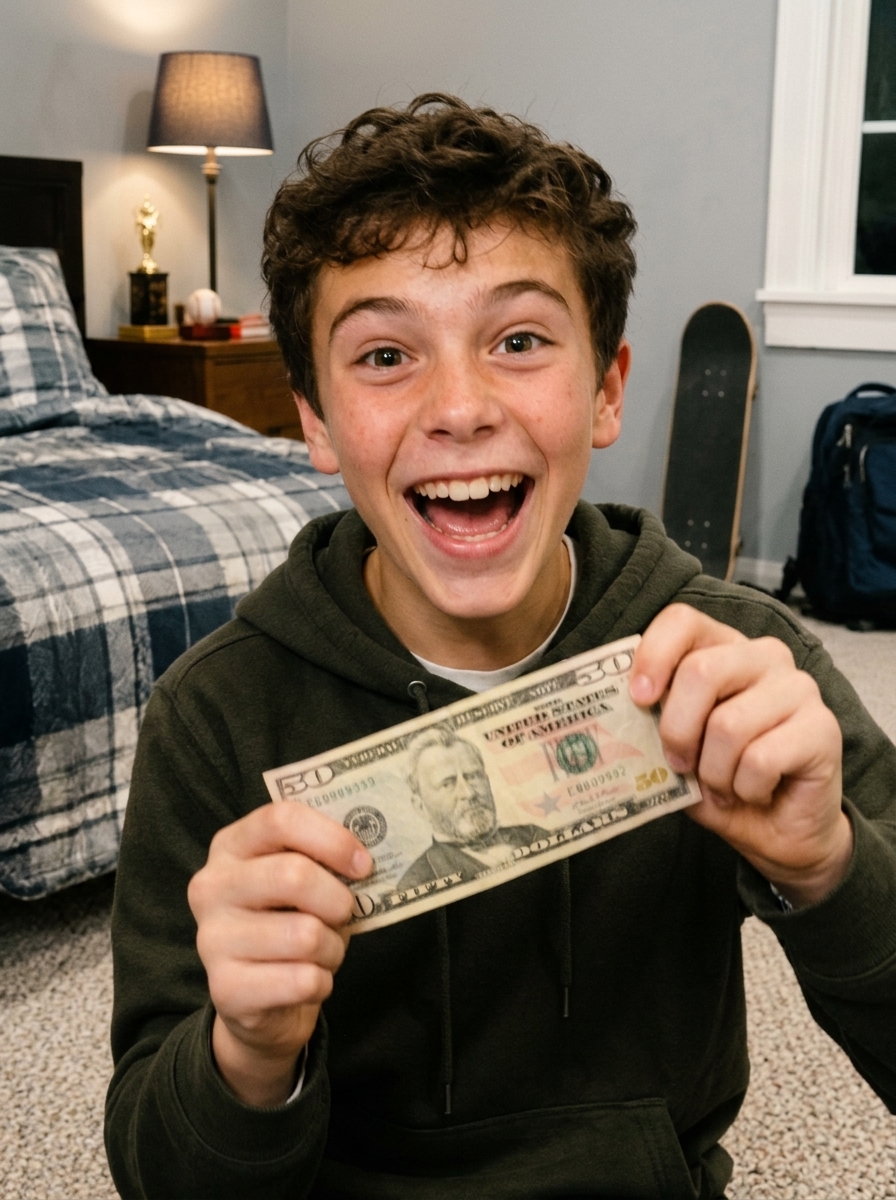
Fifty dollars.
Fifty fair tickets, bought at the official cashier’s window during the morning session.
“He used all of it?”
“All fifty,” she said.
“Then he made something I don’t think any of us thought to make.”
I looked back at Gavin.
He was helping a boy count change, patiently explaining that the extra coins could stay in the boy’s pocket.
The tears in Mrs. Gallagher’s eyes suddenly made a little more sense.
But I could tell there was more to the story than a generous purchase.
PART 4: THE BOY WHO WOULD NOT TAKE A TICKET
I started toward him, but Mrs. Gallagher touched my elbow.
“Before he sees you, I think you should know why he started.”
She led me to the edge of the bleachers, where we could watch without interrupting.
On the gym wall was a hand-painted banner announcing the Crescent Ridge Elementary Spring Fair.
The student council had planned it for weeks.
Money from game tickets would help the school library replace damaged books.
Nobody had intended to exclude anyone.
But good intentions, I was discovering, could still leave somebody standing outside the fun.
At morning recess, Gavin had noticed a classmate named Mateo sitting beside the drinking fountain.
Mateo had transferred that winter.
He was quiet, loved astronomy, and usually shared his colored pencils with anyone who asked.
Gavin had been talking excitedly about the fair when he noticed Mateo watching the other children count their spending money.
“You coming?” Gavin had asked.
Mateo shrugged.
“Maybe I’ll look around.”
“Didn’t your mom give you tickets?”
“No.”
Gavin was eleven, not a trained counselor.
He asked the next question too loudly.
“Why not?”
Mateo looked away.
“Because we need the money for other stuff.”
Several children heard.
One boy laughed and said fifty cents wasn’t going to bankrupt anybody.
Mateo’s face changed.
He took his sketchbook and walked away.
Mrs. Gallagher noticed the exchange but was helping settle another disagreement.
By the time she reached Mateo, he had said he was fine and asked to go back inside.
“Gavin came to my desk about five minutes later,” she told me.
“I thought he was going to ask whether the prize booth had any robots.
Instead, he asked why the fair needed money at the door when the library was supposed to belong to everyone.”
“What did you say?”
“That fundraisers pay for things the school otherwise can’t afford. And that students could still walk around and enjoy the decorations.”
“He didn’t like that answer.”
“He asked whether watching other children have fun counted as having fun yourself.”
I felt that question land somewhere painfully familiar.
I remembered taking Gavin to the playground years earlier and telling him we couldn’t afford the ice cream truck.
He never complained.
He simply held my hand and watched the other children eat.
“He asked permission to use his own tickets for other students,” Mrs. Gallagher continued.
“I said yes, as long as the exchange was voluntary and nobody was pressured to explain why they needed one.”
“And then?”
“Then he asked for a shoebox.”
PART 5: A RULE NOBODY HAD WRITTEN DOWN
By the time Gavin noticed me, the line had shortened to a dozen children.
He saw my face and immediately looked worried.
“Mom? Why are you here? Am I in trouble?”
I knelt beside the table.
“Your teacher called me.”
His eyes flew toward Mrs. Gallagher.
“I knew it. I told her I didn’t steal anything.”
“You’re not in trouble,” she assured him.
Gavin looked at the cashiers across the gym, then at me.
“I used the money you gave me. All of it. But you said I could spend it however I wanted.”
“I did.”
“And I wanted everybody to play.”
He glanced toward the line.
I could see him trying to decide whether hugging me in front of this many people would permanently destroy his social reputation.
“Does that mean you’re mad?”
“No, honey. I need you to tell me how this works.”
He grabbed the clipboard.
He had drawn three columns: tickets bought, tickets donated, tickets shared.
Each group had tally marks in careful pencil strokes.
He had kept a running count so nobody could accuse the table of taking fundraiser money.
“I bought fifty,” he explained.
“Then a bunch of kids started putting theirs in. Some people only had one ticket and didn’t want to give it away, and that’s okay. Nobody has to.”
The story continues…