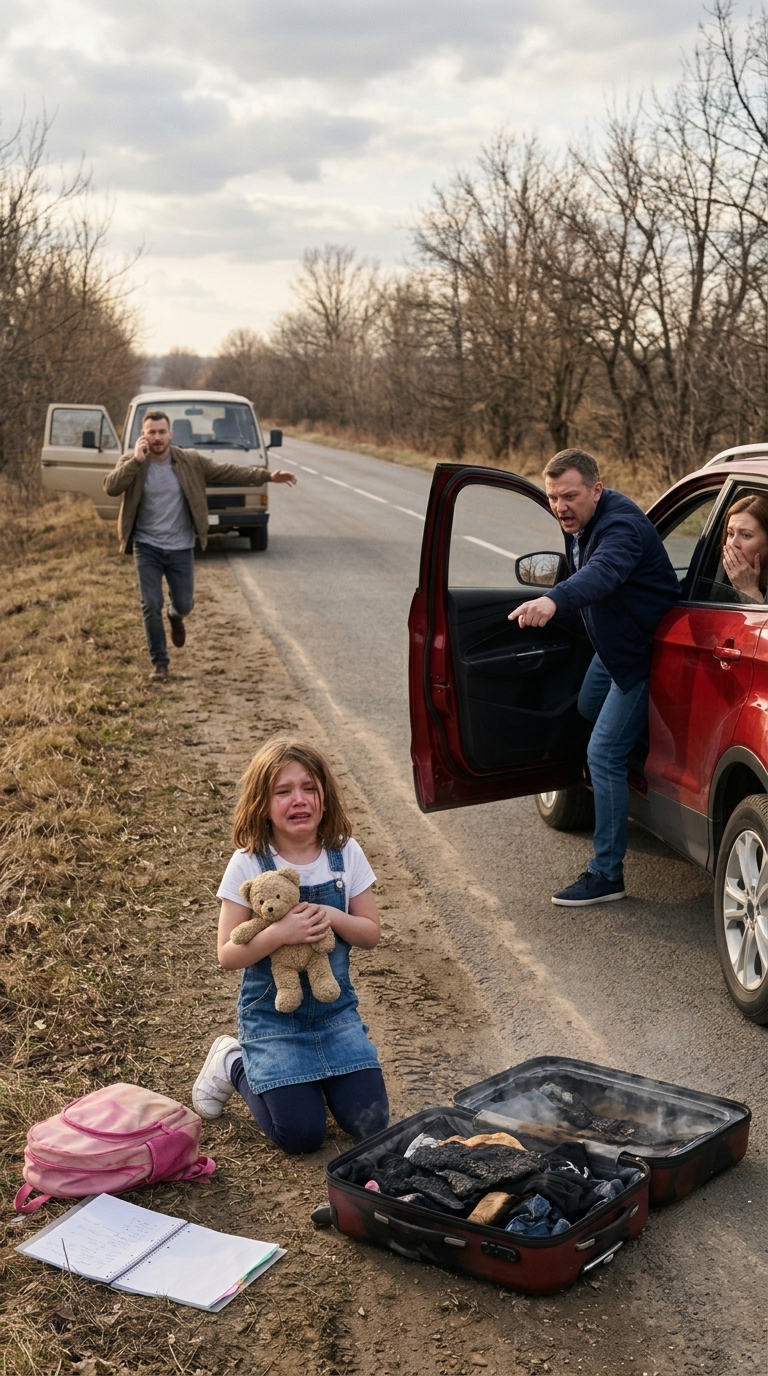
My father tossed my suitcase onto the gravel roadside and set it alight when I was only thirteen years old.
We were traveling along a deserted country stretch outside of Columbus, Ohio when Dad suddenly slammed on the brakes, stepped out of the sedan, and pulled my battered luggage from the trunk.
“Get out of the car right now, Abigail,” he ordered in a cold voice that sent a chill straight down my spine.
At first, I honestly thought he was playing some kind of cruel joke on me, so I stayed buckled in the backseat and stared at him in confusion.
Then he ripped the zipper open, scattered my clothes across the dry weeds beside the road, and pulled a red plastic gasoline can from the rear cargo space to douse everything in fuel.
“Dad, what on earth are you doing to my things?” I cried out as I scrambled out onto the pavement in my socks.
He did not answer my question, instead striking a wooden match against the box and tossing it onto the soaked pile of fabric.
Within mere seconds, bright orange flames leaped into the evening air and consumed every single item I had packed.
“You are no longer a part of this family, and you are never to come back to our house,” he declared while pointing a trembling finger at my chest.
My mother remained completely frozen in the front passenger seat, gripping her purse in her lap and refusing to even turn her head to look at me.
My younger brother, Lucas, pressed his small face against the rear glass and watched me silently as Dad shifted into drive and sped away down the highway.
I stood barefoot on the rough shoulder of the road, watching thick black smoke drift upward into the twilight from the ashes of my belongings.
I had no cell phone in my pocket, not a single dollar to my name, and no clue how many miles away we were from our neighborhood in Worthington.
“Please, somebody help me,” I whispered to the empty trees as the temperature began to drop and darkness settled over the fields.
Eventually, a passing pickup truck slowed down near the smoldering fire, and the kind driver immediately pulled over to check on me and contact the local sheriff.
When a uniformed deputy arrived and asked for my parents’ home address, I gave him every detail clearly without hesitating.
Then I spoke the words I had never dared to utter before, even though a desperate, aching part of me still wanted to run down the road after their taillights.
“I do not want to return to that house, Officer, especially not after what my father just did to me,” I told him while wiping the soot from my cheeks.
The deputy studied my face quietly for a long moment before placing his heavy wool coat around my shaking shoulders.
“You do not have to be afraid anymore, kiddo, because you are completely safe here with us,” he assured me in a gentle tone.
I initially stayed with my aunt and uncle in Cincinnati for a few months before the state eventually placed me into the foster care system.
I never reached out to my parents or my brother afterward, choosing instead to close that painful chapter forever.
Many years went by, and I worked hard to build a quiet, stable life for myself in Minneapolis without ever looking back.
Then, just last week, a thick cream colored wedding invitation arrived inside my apartment mailbox.
My little brother, Lucas, was finally getting married at a historic chapel in Madison, Wisconsin.
I nearly tossed the fancy card straight into the recycling bin without opening the inner flap.
Before I could drop it, however, I spotted a smaller, slightly wrinkled envelope tucked secretly behind the reception details.
Written across the front of that hidden note, in my mother’s unmistakable cursive handwriting, were six urgent words: “Please read this before the wedding.”
I carefully slid my finger under the seal and unfolded the lined piece of stationery.
The very first sentence on the page left my fingers feeling completely numb as I stood in my hallway.
“Your father lied to you about everything that night, Abigail,” the letter began.
I truly believed I had buried those awful memories twenty years earlier when I walked away from the ashes on that highway.
Yet a single piece of paper suddenly challenged every single thing I thought I knew, proving that the reality was far more complicated than the story I had believed since childhood.