PART 1:
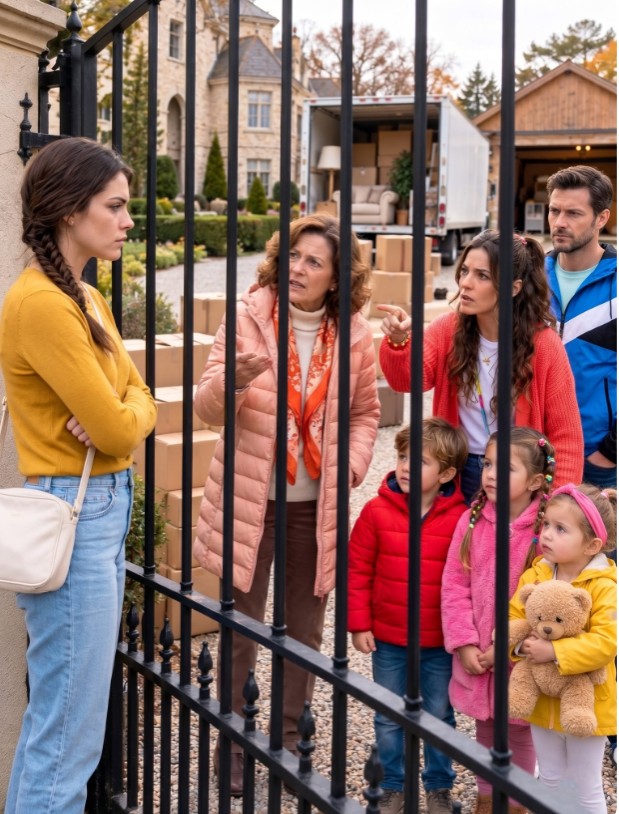
My mother kicked me out of the house when I was nineteen just to give my bedroom to my twin sister. Twelve years later, she showed up at my gate with my sister, three kids, and a moving truck, convinced she could move right in and claim the house and business I had built all on my own.
The first thing she said wasn’t “hello.”
“Open the gate, Paige. We’ve been driving three hours and the kids are tired.”
Her voice came through the intercom while I was going over payroll for my twelve employees.
On the security monitor, I saw Diane Whitaker, my mother, in a beige coat, with the same impatient expression I’d known since I was a child. Next to her stood my twin sister Mallory, her husband Grant, and their three kids. A moving truck took up half the gravel driveway.
They had unloaded several boxes and lined them up next to the gate.
Every one of them was neatly sealed with packing tape.
Nobody had asked me whether they could come.
“The downstairs bedroom will work perfectly for us,” Mallory announced, stepping up to the camera. “The kids can take the rooms down the hall.”
Grant pointed at my workshop, which stood apart from the house.
“Does that building have heat? I could start my furniture business in there.”
I listened to them divide up my property as if I had already handed over the keys.
“Don’t make me go through this embarrassment in front of the neighbors,” my mother warned.
I stared at the screen. I was thirty-one years old, my hair was pulled back in a braid, and I was still wearing my blue work shirt. In my pocket, I kept my grandmother Elaine’s old folding ruler.
For twelve years, I had imagined this reunion. In my head, I always found the perfect speeches.
But looking at them outside that closed gate, I realized I didn’t need many words.
Mallory and I were born seven minutes apart. To my mother, those seven minutes seemed to give my sister the right to receive everything good first.
She had the bedroom with the window, the new coats, the dance classes, and the birthday parties.
I got her hand-me-downs.
“You’re independent, Paige,” Mom would say whenever Mallory needed something that belonged to me.
It took me years to understand that “independent” meant nobody planned to help me.
The only one who saw what was happening was my grandmother Elaine.
On Saturdays, she took me to antique markets. She taught me to recognize repaired furniture and to spot good wood under a coat of cheap paint.
“Never be ashamed of a crack,” she’d tell me. “What matters is knowing what caused it.”
In her kitchen, I could talk without anyone telling me to be quiet.
When she died, during my senior year of high school, the only person who stood up for me was gone.
A few months after we graduated, Mallory announced she was pregnant.
Her boyfriend Grant moved into our rented house with two laundry baskets, an enormous TV, and no steady job.
Mom decided my bedroom was the only one big enough to put a crib in.
“I can sleep on the couch until college starts,” I offered.
“Grant has back problems. He might need the living room.”
“What about the basement?”
“We’ll use it for the baby’s things.”
Finally, she crossed her arms.
“You’re nineteen now, Paige. Someday you’ll have to stop being my responsibility.”
Mallory stood behind her, stroking her belly.
“You always say you don’t need anyone. Well, prove it.”
I stuffed my clothes into two black garbage bags while they watched TV.
On my way out, Mom handed me a few cans of soup and a package of cookies.
“If anyone asks, tell them you decided to be independent. It sounds better.”
For weeks, I slept on friends’ floors. When I couldn’t keep imposing on them, I bought a cheap tent and hid it behind some warehouses near a flea market on the outskirts of Ridge Hollow.
I washed up in gas station bathrooms before work. I kept my one clean shirt in a plastic bag to protect it from the damp.
One rainy afternoon, while I was collecting shopping carts at the supermarket, I saw my mother’s car.
Our eyes met through the windshield.
Mallory was in the passenger seat, laughing at something on her phone.
Mom recognized me.
She didn’t stop.
That night, I held my cell phone for almost an hour. I wanted to call her, to ask how she could have seen me like that and kept driving.
Instead, I promised myself that someday I would have a place nobody could throw me out of.
And now, twelve years later, I was looking at that same woman through a camera.
“Paige, stop being difficult,” Mom insisted.
Then Mallory pulled a clear folder out of her purse and held a sheet of paper up to the lens.
“I don’t understand why you’re acting like this. Mom said everything was arranged.”
I zoomed in from my desk.
At the top, it read: “Housing Authorization.”
Below it was my full name.
And at the bottom was a signature that was supposed to be mine.
My hands went cold.
I had never signed that document.
FULL STORY – PART2
The page Mallory was holding up to the camera had my full name and a forged signature. My mother had drawn up a housing authorization without consulting me and, apparently, had told the whole family I was on board.
I asked Mallory not to unload any more boxes. She frowned and said the truck was already paid for. I took a screenshot of the monitor and told the driver, who could hear me over the intercom, that nobody had permission to enter or unload furniture on my property.
The last time my mother had seen me before that morning, I was collecting shopping carts in the rain. After that day, I stopped waiting for her to come back for me.
Gloria and Walt, who ran the flea market near where I hid my tent, figured out my situation and offered me work repairing furniture. I started with two broken chairs and borrowed tools. I studied woodworking, saved for years, and took jobs other people turned down.
Later, I moved to Asheville, North Carolina, where I turned that craft into a restoration shop with twelve employees. I bought my house with the profits from my own work, not with a dime from my family.
My mother didn’t know all those details, but she did know I had a big house and a workshop. Months earlier, she had started asking how many rooms were empty and whether the business had space for Grant.
When I understood what she was after, I texted her that I couldn’t house them or lend them the workshop. I saved that conversation and consulted Lucy, my attorney, because Mom kept sending photos of furniture she said she’d be bringing.
That was why I had reinforced the cameras and updated my access paperwork. I hadn’t expected a moving truck, but I wasn’t about to be left unprotected again.
“Mom assured us you’d said yes,” Mallory said when I explained that the authorization was fake.
“I never authorized anything,” I answered. “And I told her so in writing six weeks ago.”
My mother leaned toward the intercom.
“I’m your mother, Paige. You can’t leave your nephews and niece out on the street over a piece of paper.”
I reminded her that she had left me without a roof at nineteen.
“It’s not the same. Mallory had a baby on the way,” she shot back.
“And I was your daughter,” I said.
For a few seconds, nobody spoke. Grant looked at my sister as if he were beginning to realize the supposed agreement had never existed.
On my computer, I pulled up the text where I’d refused to house them and showed its date over a video call I started with Mallory. Then I sent a copy to Lucy.
The signature on the document didn’t match the one on my deed, and I had never received that form. Mallory started going through her messages from our mother and discovered that Diane had assured her I was thrilled to have them.
“I knew that if I asked her directly, she’d come up with an excuse,” my mother muttered.
That confession changed Mallory’s expression more than anything I could have said.
The driver stopped unloading the boxes when I confirmed I was the owner and hadn’t authorized the delivery. My neighbor Martha came out when she heard the argument, and Tom, my shop foreman, stayed by the entrance to keep my employees’ access from being blocked.
Lucy called and advised me to keep the recordings, the document, and the messages without arguing any further about the property.
Since the truck was still stuck across the driveway, I asked the local police for help. The officers didn’t settle any family dispute. They simply verified that nobody had permission to enter and asked that the access be cleared.
My mother broke down in tears when she realized I wasn’t going to open the gate. She said she had sacrificed so much for her daughters and that I was punishing innocent children.
I looked at my niece and nephews sitting in the car, exhausted, not understanding the fight.
I gave Mallory and Grant information on nearby motels and told them they could sort out their situation without invading my home. Grant agreed to look for a place to spend the night. Mallory was furious with me, but also with Mom.
“You made us bring the kids because you swore Paige was expecting us,” she told her.
Diane didn’t answer. The driver restacked the boxes and closed the lift gate.
Over the following days, Lucy documented the forged signature and sent a notice making it clear that nobody could use my address or my workshop without written authorization. I filed a formal record of what had happened, without inventing a courtroom victory that didn’t exist.
A few weeks later, I got a message from Mallory. She acknowledged that our mother had lied about the permission and said she was sorry she’d shown up without talking to me first.
I replied that I appreciated her admitting it, but that she had also chosen to discuss how to divide up my rooms before asking whether she could come in.
I didn’t offer her keys, money, or an immediate reconciliation.
Months later, one morning, I found my grandmother Elaine’s old folding ruler among my tools. I opened it on the table where I inspected finished pieces and remembered her words about cracks in wood.
For years, I had believed that healing meant convincing my mother I deserved love too.
Now I understood that I could build a dignified life even if she never acknowledged what she’d done.
Outside, I could hear the machines in the shop and the voices of the people who worked with me.
My house was still my house.
The lock wasn’t revenge. It was the boundary I could finally keep