Spring returned slowly.
The hydrangea cutting put out new leaves.
I signed up for swimming lessons at the community pool.
On the first day, I stood in shallow water while a woman young enough to be my granddaughter told me to lean back.
“I’ll sink,” I said.
“I’m right here.”
I tried.
Water filled my ears.
The ceiling moved.
For a breath, I panicked.
Then my body floated.
Supported by something I had spent years afraid to trust.
When I stood again, I was laughing.
The instructor grinned.
“There you are.”
I went every Wednesday.
By May, I could cross the pool without holding the edge.
Cedric learned about it from the children.
“You swim now?”
“I do.”
“Since when?”
“Since I started learning.”
He smiled at that.
I smiled back.
Some facts about me would arrive in his life late.
He could learn them when they arrived.
He and Jessica were still in the apartment.
They had made a budget.
They argued sometimes, and once Jessica told me they were learning to stop arguments before the children became their unwilling audience.
I listened.
I did not become their referee.
Cedric missed one coffee because of work.
He called ahead.
We rescheduled.
Another time, he made a cutting remark about Jessica being slow.
I saw her face close.
Before I could speak, he stopped himself.
“That was unfair.”
She looked at him.
“Yes.”
“I’m sorry.”
The conversation resumed awkwardly.
I preferred the awkwardness to the old laughter.
Change did not make a polished entrance.
Sometimes it arrived as a man noticing his own sentence before somebody else had to carry it home.
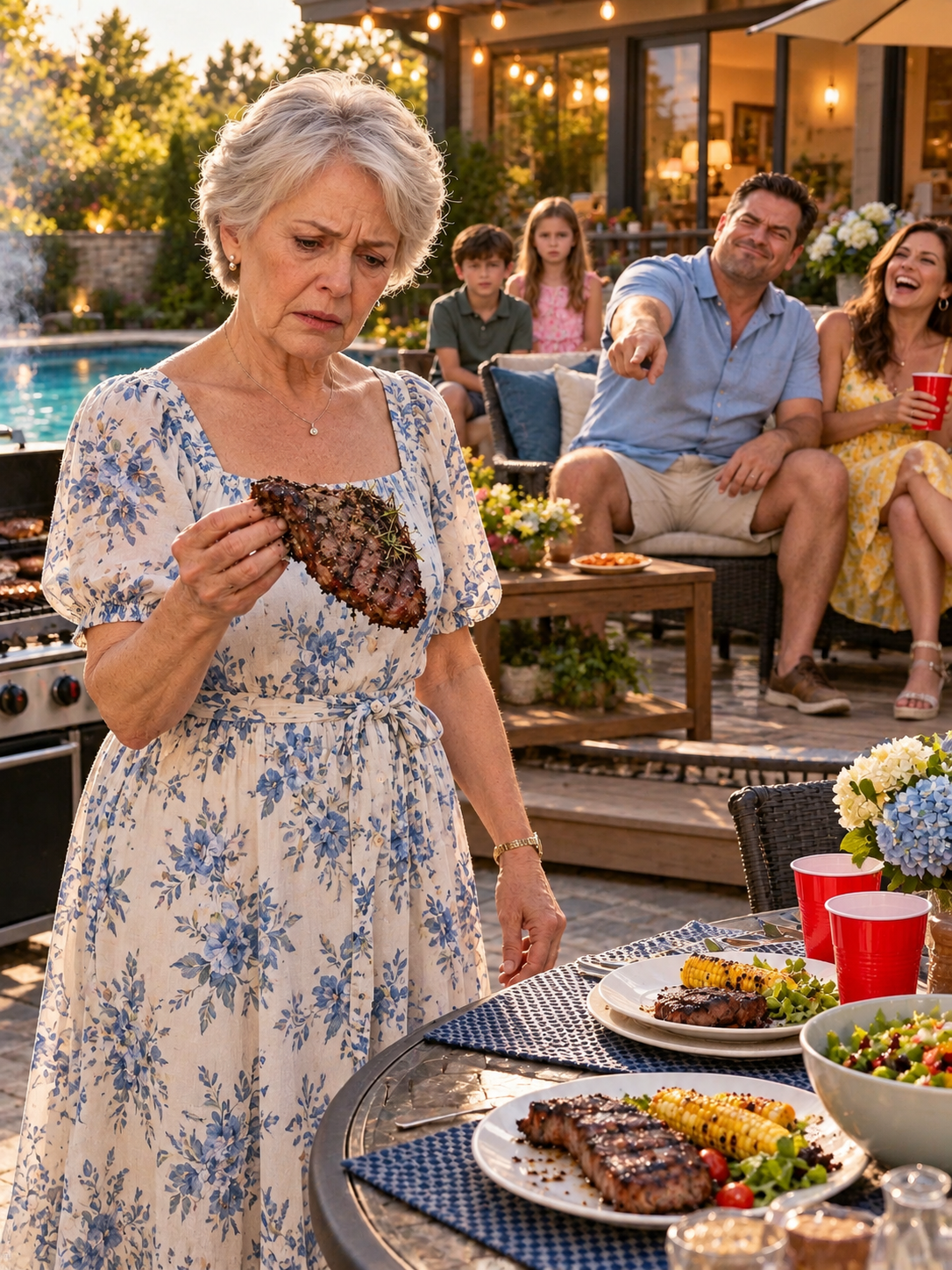
A year after the barbecue, I invited them to the garden courtyard.
The manager allowed small family gatherings if we cleaned afterward.
Martha came.
Ruth brought potato salad.
Noah carried binoculars as if rare eagles might visit our suburban roses.
Lily had grown tall enough to complain that everybody kept mentioning it.
Cedric brought the food.
He had asked beforehand what I wanted.
“Steak,” I told him.
There had been a long pause.
“All right.”
Now he stood beside the little grill, watching the meat carefully.
No beer in his hand.
No audience to impress.
When dinner was ready, he brought my plate himself.
He set it down and looked at me.
“Is this how you wanted it?”
I cut into the steak.
A thin line of pink showed beneath the browned surface.
“Yes,” I said. “It is.”
He nodded and went back for everyone else’s plates.
That was all.
Nobody made a speech.
Nobody asked me to call the moment healing.
Lily told a long story about a school play.
Ruth disagreed with Martha about the proper amount of mustard in potato salad.
Noah spotted a goldfinch and nearly dropped his fork.
Cedric sat down only after checking that Jessica had her dinner.
I saw it.
I let myself see it.
Later, when the children ran to examine the birdbath, he sat beside me on the bench.
“I used to think you selling the house was the worst thing you could do to me.”
I looked at the garden.
“And now?”
He rubbed his hands together.
“Now I think I was waiting for your whole life to become mine.”
The words came slowly.
He seemed to be discovering them as he spoke.
“I didn’t think about what you’d have left.”
I watched a bee move between the flowers.
“I almost didn’t either.”
He turned toward me.
“I’m glad you did.”
I believed him.
Belief did not mean giving him another key.
It meant I could sit beside my son without arranging excuses between us.
When it was time to leave, he packed the leftovers into containers he had brought.
Jessica wiped the table.
The children collected napkins from beneath the chairs.
Lily kissed my cheek.
“Next time, can we make pancakes?”
“Yes. Next Saturday.”
Noah checked the feeder one final time.
“Don’t forget the seeds.”
“I won’t.”
They left in their ordinary family car, arguing mildly about music.
I watched until they turned the corner.
Then I went upstairs.
My apartment smelled faintly of flowers and cooked dinner.
The evening sun lay across my reading chair.
On the table, beside the blue bowl, stood the old photograph Renee had found.
I had placed it in a frame large enough to show the handwriting on the back when I turned it around.
First home that’s ours.
For years, I had read that sentence as a vow to provide a place nobody could take from my child.
Now I understood the woman in the picture had been standing on those steps too.
I touched the frame.
“You got a room,” I whispered.
Outside, a bird landed on Noah’s feeder.
It tilted its head, scattered seeds exactly as he had warned, and settled in to eat.
I filled the kettle.
I took one cup from the cupboard.
Tomorrow, I had swimming.
Saturday, there would be pancakes.
Next month, Martha and I were taking another train.
There was room for my family in the life I had chosen.
There was room for quiet, for disappointment, for affection that asked permission before entering.
And at the center, where I had once left an empty space for everyone else’s needs, there was finally a place for me.
The kettle clicked off.
I carried my tea to the balcony, lowered myself carefully into my favorite chair, and watched the garden until the light grew soft.
I stayed because I wanted to.
And when I was ready, I went inside, closed my own door, and rested.