The Recording
The hospital doors opened before we even reached them.
Medical staff rushed Veta inside.
I followed.
For almost two hours, I sat in a hospital corridor staring at the same empty chair.
Eventually, a doctor came out.
“She is stable.”
My entire body relaxed.
“Can I see her?”
“In a few minutes.”
I closed my eyes.
For the first time since arriving at the house, I allowed myself to breathe.
Then my phone vibrated.
A message from Kieran.
I opened it.
There was a video attached.
“Don’t watch this alone,” he wrote.
I pressed play.
It was the footage Declan had recorded.
At first, I saw Bellamy complaining about the machine.
Then I heard her say:
“I’m sick of this thing making noise.”
The camera moved.
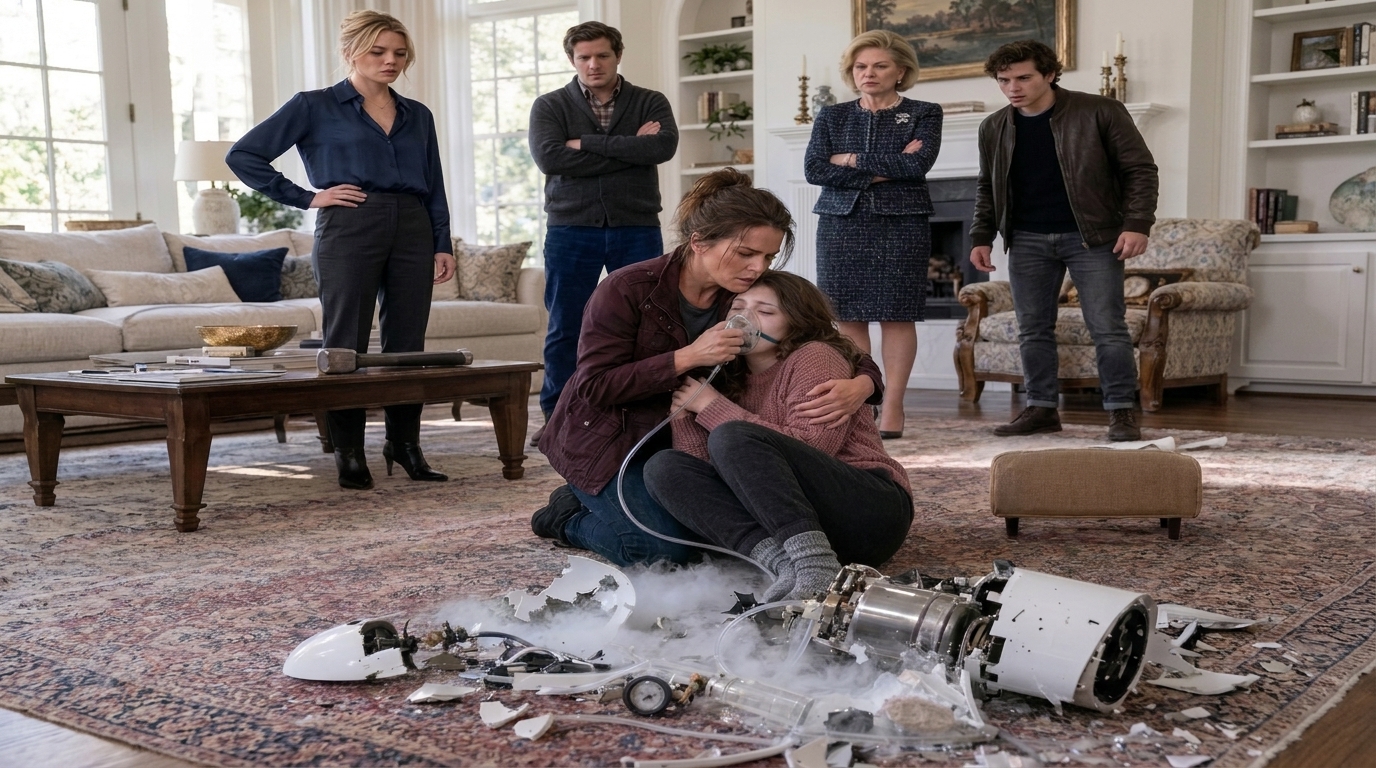
Bellamy picked up the hammer.
Kieran’s voice came from behind the camera.
“Bellamy, stop.”
She ignored him.
The recording showed the equipment being damaged.
Then Veta appeared in the frame.
She was frightened.
She looked at her father.
“Dad, please.”
Declan’s voice answered.
“You’re always making everything dramatic.”
Then Bellamy said:
“Maybe she’ll finally learn.”
The video ended.
I stared at the screen.
But something bothered me.
There was a missing section.
The video jumped forward.
I watched it again.
And again.
Someone had deleted approximately forty seconds.
I immediately called Kieran.
“What happened during the missing part?”
“I don’t know.”
“You were there.”
“I was outside the room by then.”
“Who was recording before Declan?”
Silence.
Then Kieran said:
“Una.”
My stomach tightened.
“Your mother?”
“Yes.”
I asked him to send me everything he had.
He did.
There were photographs.
Messages.
Security camera screenshots.
And then I saw something I wasn’t expecting.
A photograph of Bellamy standing beside the oxygen system three days before the incident.
She wasn’t merely standing there.
She was examining the control panel.
A handwritten note was visible beside her.
I zoomed in.
It contained Veta’s equipment settings.
My heart sank.
This hadn’t been spontaneous.
Someone had been planning something.
The next morning, Veta woke up.
I sat beside her bed.
She looked exhausted.
“Mom?”
“I’m here.”
“Is Dad coming?”
I hesitated.
“No.”
Her eyes lowered.
She didn’t cry.
That somehow hurt more.
After a moment, she whispered:
“I still want to know why he hates me.”
“He doesn’t hate you.”
She looked at me.
“Mom.”
I couldn’t lie anymore.
“I don’t know why he made those choices.”
She looked toward the window.
Then she said something that changed everything.
“Dad knew.”
“Knew what?”
“About the machine.”
“What do you mean?”
“Bellamy told him she was going to destroy it.”
My heart stopped.
“When?”
“Two days ago.”
“Why didn’t you tell me?”
“Because Dad told me not to.”
“Why?”
Veta swallowed.
“He said if I told you, you’d stop letting me visit him.”
I couldn’t speak.
My daughter had been protecting the man who had failed to protect her.
Then she reached beneath her pillow.
She pulled out a small envelope.
“I found this in Dad’s office.”
I opened it.
Inside was a printed insurance document.
The oxygen equipment was insured for $130,000.
But there was something else.
A second page.
A beneficiary form.
Declan had recently changed the policy.
The beneficiary wasn’t Veta.
It was Bellamy.
I stared at the document.
Suddenly, the destroyed equipment wasn’t just an act of cruelty.
There might have been money behind it.
FULL STORY — PAGE 3
The Family Secret
Three days later, the police interviewed everyone.
Bellamy claimed it was an accident.
Declan claimed he had been trying to calm everyone down.
Una claimed she had been protecting the family.
But Kieran gave them the original footage.
And then another witness came forward.
A neighbor.
She had a security camera facing the driveway.
Her footage showed Bellamy arriving at the house carrying a large tool case.
She entered the house alone.
Twenty-three minutes later, the medical emergency began.
But the biggest revelation came from someone nobody expected.
Margaret.
Declan’s elderly aunt.
She contacted me privately.
“I know why they wanted the machine destroyed.”
I met her at a quiet café.
She placed a folder on the table.
“I’ve been keeping these for years.”
Inside were financial documents.
Declan’s business had been struggling.
Bellamy had accumulated significant debt.
And someone had discovered that Veta’s equipment had an unusually large insurance value.
Margaret looked ashamed.
“Declan wanted the insurance money.”
I couldn’t believe it.
“He was going to let them destroy his daughter’s medical equipment?”
Margaret nodded.
“But Bellamy went further than he expected.”
“What do you mean?”
“She wasn’t supposed to damage the primary system. She was supposed to make it appear defective.”
My hands became cold.
Margaret continued.
“Declan planned to file an insurance claim.”
“And Veta?”
Margaret looked down.
“He thought you would replace the machine.”
I stared at her.
“So he was willing to risk her life for money.”
“Yes.”
For several seconds, neither of us spoke.
Then Margaret said:
“There is one more thing.”
She pushed another envelope across the table.
Inside was a handwritten letter.
Declan had written it months earlier.
It said:
“Once the equipment is replaced, Sloan will have no reason to keep interfering with Veta’s visits.”
I read it twice.
Then I realized something.
This wasn’t only about money.
Declan wanted control.
He wanted Veta to depend on him.
He wanted me out of the picture.
And he was willing to manipulate his own daughter to get it.
Weeks passed.
Veta slowly recovered.
The authorities collected the evidence.
The insurance company opened its own investigation.
Bellamy was no longer allowed near Veta.
Declan stopped calling.
Then, one afternoon, he appeared outside the hospital.
I stepped into the hallway to meet him.
“You need to leave.”
“I want to see my daughter.”
“You had the opportunity.”
He looked broken.
For the first time, he didn’t seem angry.
He seemed afraid.
“I made a terrible mistake.”
“You made several.”
“I didn’t think Bellamy would go that far.”
“That doesn’t excuse you.”
He lowered his head.
“I never meant for Veta to get hurt.”
I stared at him.
“You watched her struggle to breathe.”
His eyes filled with tears.
“I know.”
“You recorded it.”
“I know.”
“You laughed.”
He couldn’t answer.
Then I said the sentence I had been carrying for years.
“You didn’t lose your daughter because of our divorce, Declan.”
He looked at me.
“You lost her because she kept asking you to choose her, and you kept choosing yourself.”
He began crying.
But I walked away.
Because forgiveness is not the same thing as permission.
And love does not require someone to remain in danger.
Six months later, Veta returned home.
Her new medical system had been installed.
It was quieter.
Smaller.
More reliable.
She sat beside me in the backyard one evening.
“Mom?”
“Yeah?”
“Do you think Dad will ever change?”
I thought carefully.
“I don’t know.”
“Do you hate him?”
“No.”
She looked surprised.
“Why not?”
“Because hate would keep him inside my life.”
She smiled faintly.
Then she leaned against my shoulder.
“I think I’m finally done trying to make him love me.”
I kissed the top of her head.
“You never had to earn his love.”
She closed her eyes.
“I know that now.”
For the first time in years, she looked peaceful.
Then my phone rang.
Unknown number.
I answered.
A man’s voice spoke quietly.
“Ms. Sloan?”
“Yes.”
“We found something else.”
My heart tightened.
“What?”
“It concerns your daughter’s medical records.”
I stood.
“What about them?”
“The equipment failure wasn’t the only thing that was manipulated.”
I looked at Veta.
“What are you saying?”
The man hesitated.
“Someone altered her medical records almost two years ago.”
My blood ran cold.
“Who?”
“We don’t know yet.”
“Why?”
Another pause.
“Because whoever did it wanted doctors to believe Veta’s condition was worse than it actually was.”
I couldn’t breathe.
“Why would anyone do that?”
The man lowered his voice.
“Because it would make her completely dependent on specialized equipment.”
I stared at the house.
At Veta.
At the life we had spent years believing was unavoidable.
Then he said:
“We found one name connected to the original records.”
I gripped the phone.
“Whose?”
He answered.
And everything I thought I knew about my daughter’s illness changed forever.
The name wasn’t Bellamy.
It wasn’t Declan.
It wasn’t Una.
It was someone I had trusted more than any of them.
Someone who had been beside Veta from the beginning.
And suddenly, the destroyed $130,000 machine wasn’t the beginning of the story.
It was only the first piece of a secret that had been hidden from us for nineteen years.
I looked at my daughter.
She was smiling at the sunset, completely unaware that her entire medical history might have been built on a lie.
I lowered the phone.
And whispered:
“Veta… we need to talk.”
She looked up.
“About what?”
I stared into her eyes.
“About the day you were born.”
FULL STORY — PAGE 4
Veta’s smile faded.
“What happened the day I was born?”
I sat down beside her again.
For a moment, I could hear only the quiet sound of her new equipment.
“I don’t know the whole answer yet,” I said. “But someone has found changes in your medical records. We need to find out what was changed, and who was involved.”
She looked at the phone in my hand.
“Who did he say?”
“Kieran.”
She pulled away just enough to look directly at me.
“Uncle Kieran called you. He helped me.”
“I know.”
“Then why is his name there?”
“That’s what we’re going to ask.”
I wanted to promise there was an innocent explanation.
But I had already spent too many years giving Veta assurances I couldn’t support.
Before doing anything else, I called the hospital through its main number and verified the caller’s identity. He was working with the investigation into the altered records.
Then, with Veta’s permission, I asked her medical team to arrange a review of her complete history.
We did not turn off her equipment.
We did not change a single setting.
Whatever someone had written in a file, I had seen my daughter unable to breathe.
That emergency had been real.
Kieran agreed to meet us.
Veta wanted him to come to the house. She wanted to hear his answers herself.
When he arrived, he stopped in the doorway.
“You know,” he said.
I felt Veta’s hand tighten around mine.
“Tell us what we know,” I answered.
He sat opposite us, but he couldn’t look at her.
“Your father asked me to send some records to the clinic almost two years ago.”
“Whose records?” Veta asked.
“Yours.”
“Why you?”
“Because I had copies of the old family paperwork. I’d helped him with it when you were a baby.”
I remembered that.
The hospital. The exhaustion. The forms I could barely focus on while my newborn daughter lay surrounded by medical equipment.
Kieran had been the one who brought food, collected paperwork, and told me to stay beside her.
“What did you send?” I asked.
He rubbed his hands together.
“An old summary. Declan wanted it submitted as if it described her current condition.”
Veta went very still.
“You knew it was old?”
“Yes.”
“And you sent it anyway?”
His eyes filled.
“Yes.”
I waited until he looked at me.
“Why?”
“He said the clinic was asking questions about the equipment authorization. He said a reassessment might interrupt her supplies.”
“So you thought that made it acceptable?”
“No.” His voice broke. “I told myself it was safer than risking a delay. But I knew the information wasn’t current.”
He had not written every false entry in her chart. He could not tell us who had copied the misleading summary into later records.
But he had helped put it there.
And he had never warned us.
“What does this have to do with the day she was born?” I asked.
Kieran finally looked at Veta.
“The original doctors weren’t certain what your long-term needs would be. You were very ill. You needed support. But they said your abilities would have to be reassessed as you grew.”
I remembered Declan returning from conversations with doctors.
Permanent, he had told me.
Nothing would change.
There was no point hoping otherwise.
“Your father wanted certainty,” Kieran continued. “He wanted everyone following one plan. Whenever there was a question about whether your needs had changed, he treated it like a threat.”
“And you let him,” I said.
Kieran nodded.
Veta’s voice was quiet.
“Was I ever going to be told?”
He had no answer.
That hurt her more than an excuse would have.
For nineteen years, uncertainty had been presented to us as certainty. Then, almost two years earlier, old information had been made to look current, carrying that same story forward.
It did not mean Veta had never been ill.
It meant we had been denied the chance to understand her illness honestly.
“Did you know about the insurance plan?” I asked.
“Not before Bellamy damaged the machine.”
“Did you think about telling us any of this when you sent me the video?”
“Yes.”
“But you didn’t.”
“I was afraid.”
Veta looked at him for a long time.
“I was afraid too,” she said. “And I didn’t get to choose whether any of this happened.”
He lowered his head.
She asked him to leave.
Before he did, I told him to give investigators the same account he had given us.
This time, helping Veta meant telling the truth even when it cost him something.
The review took weeks.
Veta attended the appointments. She asked for copies of the reports. When doctors spoke, she asked them to explain what came from current testing and what had simply been repeated from older notes.
I sat beside her.
But I no longer answered every question for her.
The specialists confirmed her rare neuromuscular respiratory disorder. They also confirmed that she still needed respiratory support.
Bellamy’s claim that she could simply learn to breathe without it had been dangerously wrong.
But parts of Veta’s recorded history overstated her limitations and failed to reflect changes over time.
Her treatment needed an individualized reassessment—not an abrupt withdrawal of equipment, and not a promise of a cure.
Some of her support could eventually be adjusted under supervision. Other needs remained.
There was no single appointment at which nineteen years of uncertainty disappeared.
There were explanations.
There were corrected records.
And there was a plan based on Veta as she was now, rather than on the version of her condition someone else found convenient.
After one appointment, she sat beside me in the car holding her report.
“So I wasn’t pretending,” she said.
I turned toward her.
“Never.”
“But they made some of it worse.”
“They made it harder for you to get honest answers.”
She looked down at the pages.
“I want the answers now. Even the ones I won’t like.”
“You’ll have them,” I said. “And when we don’t know something, we’ll say we don’t know.”
The investigation into the destroyed equipment continued alongside the medical-record review.
The original recording accounted for the missing forty seconds. The omitted passage showed that Declan had been involved in the discussion about making the equipment appear defective.
His claim that he had merely been calming everyone down did not survive it.
Neither did Bellamy’s claim of an accident.
The photograph of the control panel, the handwritten settings, the neighbor’s driveway footage, Veta’s account, the insurance documents, and Margaret’s financial records were considered together.
No single piece stood alone anymore.
The insurance payout Declan had expected did not arrive.
Bellamy and Declan ultimately faced criminal consequences for their roles in destroying the equipment and endangering Veta. The attempted insurance scheme became part of the case against them.
The driveway footage and witness accounts also placed Una’s efforts to stop us from leaving on the record.
Kieran gave a formal statement about the misleading medical summary and supplied the communications he had retained. His decision to call me during the emergency mattered.
It did not erase what he had done before it.
Veta chose not to resume contact with any of them.
When arrangements were made to prevent further unwanted contact, she read the paperwork herself before signing it.
Declan sent an apology through the permitted channel.
Veta read it once.
Then she placed it in a drawer.
“Do you want to answer?” I asked.
“No.”
I waited.
“I don’t need to explain why I want to be safe.”
“No,” I said. “You don’t.”
Months after that first evening back in the garden, we sat outside again.
Veta’s equipment stood beside her chair.
It was still part of her life.
But it was no longer something she apologized for.
Her updated medical records were in a folder inside the house. She had her own copy, her own questions for the next appointment, and a care plan she understood.
For a while, we watched the sunset without speaking.
Then she said, “I used to think if I could be easier to take care of, Dad would want me around.”
I set down my cup.
“You should never have had to think that.”
“I know.”
This time, she sounded certain.
She adjusted the tubing beside her shoulder and settled back into the chair.
“I don’t know how much things will change,” she said.
“Neither do I.”
“But I want to find out.”
I reached for her hand.
For years, I had wanted to give her a promise that everything would be all right.
Now I knew what I could honestly promise.
No more hiding information to keep the peace.
No more calling cruelty a misunderstanding.
No more asking her to make herself smaller so someone else could feel comfortable.
We would face what was real.
Together.
Veta leaned against my shoulder, watching the last light move across the garden.
The machine made a soft sound beside us.
Neither of us wished it quieter.
EDITORIAL NOTE — NOT FOR PUBLICATION
The source ended on an unresolved medical-records cliffhanger. Page 4 adds a resolution using existing characters, including Kieran’s connection to the records, a medical reassessment, and legal and emotional aftermath. The supplied scenes and stopping point are retained. Before publishing, add the actual Part 3 website link as a reply to the Part 2 comment.
Do you have an image for this story? Reply YES and upload the image, or reply NO to skip.