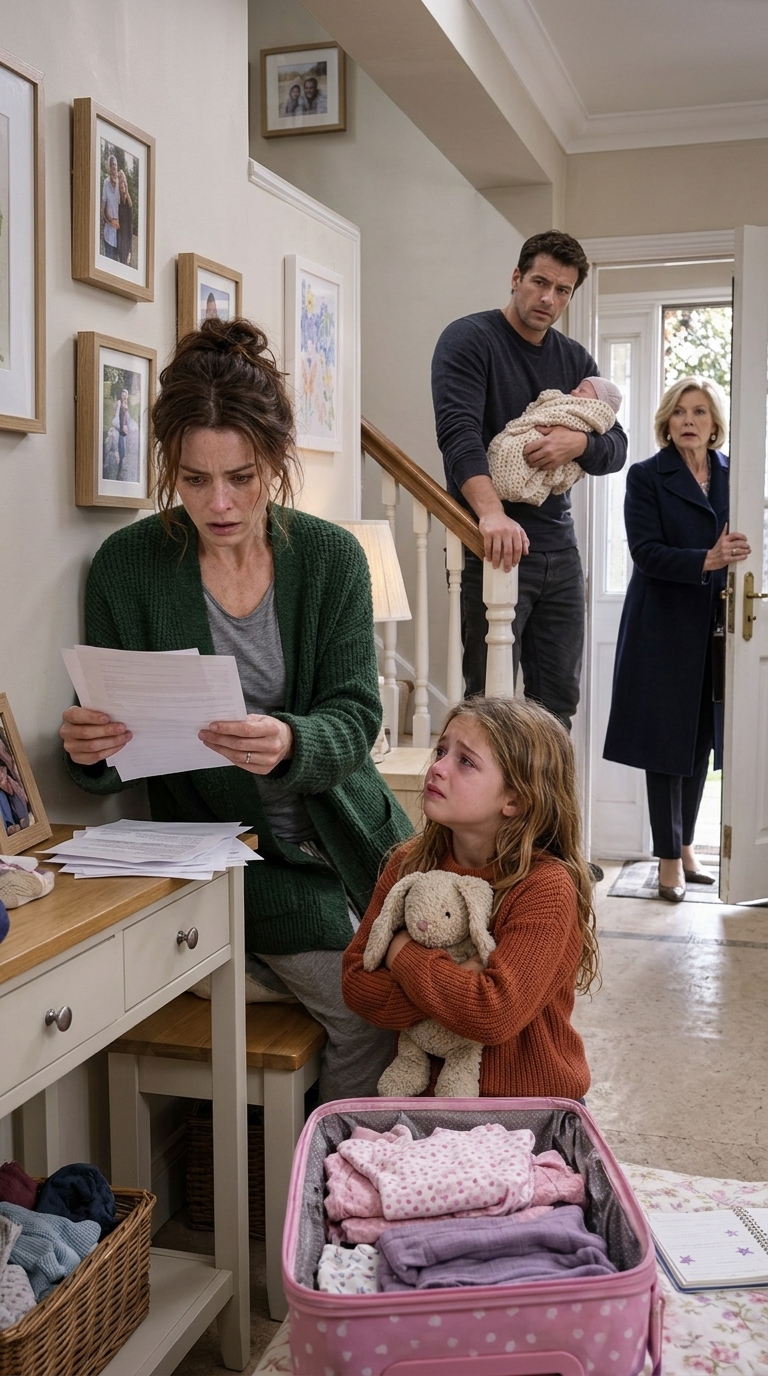
The first photograph showed me asleep on our living room couch.
My head was tilted against a cushion. One hand rested on Sophie’s pink blanket, and an empty mug sat on the coffee table.
Beneath the photograph, someone had written:
Mother unresponsive during child’s afternoon activities.
I remembered that afternoon.
It was March 14.
I’d worked a full day at the school library, picked Sophie up from dance class, helped her build a cardboard castle, and fallen asleep for twenty minutes while she watched a movie beside me.
Daniel had taken the picture.
I knew because I’d woken to the sound of his phone camera.
He’d smiled.
“You two looked so peaceful.”
Now that same photograph appeared in a document questioning whether I could care for my children.
I scrolled down.
There were 43 entries.
Forty-three ordinary moments from my life, carefully rearranged into evidence against me.
A photograph of an overflowing laundry basket.
Mother neglects household responsibilities.
A picture of Sophie eating cereal at the kitchen counter.
Child frequently prepares meals without supervision.
A screenshot of a text I’d sent Daniel after a twelve-hour workday.
I can’t do everything by myself anymore.
Underneath:
Mother acknowledges inability to manage family obligations.
I felt the wooden banister pressing into my palm.
“How long have you been doing this?”
Daniel stood three steps below me, holding Eli.
“Rachel, you need to understand the context.”
“Eight months, Daniel.”
Patricia moved toward the front door.
“I think everyone needs time to calm down.”
“You’re not leaving with my daughter.”
She stopped.
“Nobody said I was.”
I held up my phone.
“Then explain why you’ve been collecting photographs of me since March.”
Patricia looked at Daniel.
That was the first time I saw it.
Not a glance between two people surprised by an accusation.
A silent exchange between two people deciding which version of the truth to tell.
Daniel finally spoke.
“Mom was concerned about how much pressure you were under.”
“So you photographed me sleeping?”
“We were documenting patterns.”
“What patterns?”
He shifted Eli higher against his chest.
“You were exhausted all the time. You cried over little things. Sometimes you forgot appointments.”
I stared at him.
“I forgot one dentist appointment because you told me you were taking Sophie.”
His mouth tightened.
“That’s not the point.”
“Then what is?”
Patricia stepped forward.
“The point is that Sophie has been carrying more responsibility than a child should.”
Behind me, a small voice answered.
“I didn’t mind helping.”
We all turned.
Sophie stood at the top of the staircase, barefoot, with her stuffed rabbit tucked beneath one arm.
Her hair had fallen across her face.
“I can still help, Grandma.”
Patricia softened her voice immediately.
“Of course you can, sweetheart.”
Sophie looked at me.
“I can make my own cereal. And I know where Daddy keeps the clean towels.”
I crouched despite the sharp pull across my abdomen.
“Baby, you don’t have to prove anything.”
She glanced at Patricia.
“But I already got nine good days.”
The hallway went silent.
I held out my hand.
“Come here, Sophie.”
She took one cautious step.
Then another.
I wrapped my arm around her waist.
“You have never needed to earn a place in this family.”
She pressed her rabbit against my shoulder.
“Even if I have a bad day?”
“Especially then.”
Daniel looked away.
I stood carefully and faced him.
“Give me Eli.”
He hesitated.
For one terrible second, I thought he might refuse.
Then he placed our son in my arms.
Eli stirred, opened his tiny mouth, and settled against my chest.
I looked at Patricia.
“Leave.”
“Rachel—”
“You can leave now, or I can call someone to help you leave.”
Her cheeks reddened.
“You’re proving exactly why we were concerned.”
I didn’t answer.
I walked into Sophie’s room with both my children.
And I closed the door.
Twenty minutes later, my phone buzzed.
A text from Daniel.
Mom left. We need to talk like adults.
I sat on Sophie’s bed, nursing Eli while she colored beside me.
The pink suitcase remained open on the carpet.
I couldn’t stop looking at it.
Every item inside represented a decision my daughter believed had already been made.
Her pajamas.
Her library book.
Her rabbit.
She hadn’t packed her school art folder, the one containing every drawing she’d made since kindergarten.
I wondered whether she’d thought she was coming back for it.
Or whether someone had told her she wouldn’t need it.
“Sophie?”
She looked up.
“Did Grandma help you pack?”
“No. She gave me a list.”
My fingers tightened around Eli’s blanket.
“What list?”
Sophie pointed toward her backpack.
“The one with what I could bring.”
I found a folded sheet of paper inside.
At the top, in Patricia’s handwriting:
SOPHIE’S TRANSITION PLAN
Underneath were categories.
- Clothing
- School supplies
- Comfort objects
- Personal hygiene
Then, near the bottom, a section labeled:
ITEMS TO REMAIN AT ORIGINAL RESIDENCE.
Photographs.
School awards.
Large toys.
Furniture.
Family keepsakes.
Beside the final category, Patricia had written:
These items may create unnecessary attachment to the previous household.
I sat very still.
Previous household.
Not temporary visit.
Not two weeks.
Previous household.
Sophie leaned against my arm.
“Grandma said my new room is yellow.”
I looked down.
“She already has a room ready?”
Sophie nodded.
“She bought a new bed. But she said I can’t bring the butterfly lamp because it belongs to this house.”
The butterfly lamp had been a gift from my mother.
She’d given it to Sophie on her fifth birthday, two months before cancer took her from us.
Every night, Sophie turned it on before bed.
Its pale blue wings cast little shadows across the ceiling.
I touched her cheek.
“That lamp belongs to you.”
“Really?”
“Really.”
She stared at it.
Then she whispered:
“Grandma said I should practice not missing things.”
I closed my eyes.
Just for a second.
When I opened them, Sophie was watching me carefully.
“Mommy, are you tired because I talked too much?”
I reached for her hand.
“No, sweetheart. I’m tired because I just had a baby. You didn’t cause that.”
She studied my face.
“So I can tell you about my poem?”
I swallowed.
“I want to hear every word.”
She sat straighter.
Then she began reciting the poem she’d written for the school assembly.
It was about a little bird building a nest big enough for every bird in its family.
Halfway through, her voice faltered.
“I forgot the last part.”
I brushed the hair from her forehead.
“That’s okay.”
She looked toward the doorway.
“Grandma said forgetting means I didn’t practice enough.”
“Sometimes forgetting just means you’re human.”
Sophie thought about that.
Then she leaned her head against my shoulder.
For the first time all afternoon, she didn’t ask permission.
At six that evening, I called my older sister, Rebecca Hale.
Rebecca was 42, a physical therapist who lived twenty minutes away in Sewickley.
She’d helped raise Sophie during my mother’s final illness.
And she had never particularly liked Daniel.
When I explained what I’d found, she didn’t interrupt.
I heard a car door close.
“Rachel, I’m coming over.”
“Rebecca, you don’t need to—”
“I’m already in the car.”
I looked toward the bedroom door.
“I don’t know what to do.”
Her voice became very steady.
“First, save everything somewhere Daniel can’t access. Then don’t sign anything else. We’ll find an attorney.”
I glanced at the documents.
“There’s something else.”
“What?”
“The photographs go back eight months.”
Silence.
Then Rebecca asked:
“Rachel, do you remember what happened in March?”
I frowned.
“What do you mean?”
“When you and Daniel argued about your mother’s house.”
My fingers stopped moving.
My mother’s house.
The little brick property in Mount Lebanon.
The house where Sophie had taken her first steps.
The house my mother left to me alone.
I hadn’t thought about that argument in months.
But suddenly I remembered every word.
Daniel had wanted to sell the property and use the proceeds to pay down our mortgage.
I’d refused.
Not because I didn’t trust him.
Because my mother had left specific instructions.
The house was to remain in my name until Sophie turned eighteen.
After that, I could decide whether to sell it, rent it, or eventually pass it to her.
Daniel had called the arrangement impractical.
Patricia had called it selfish.
And I’d said no.
One week later, Daniel had started taking photographs.
I sat upright.
“Rebecca, do you think this is connected?”
She didn’t answer immediately.
“I think we need to look at everything.”
Rebecca arrived carrying two grocery bags and a laptop.
She kissed Sophie, admired Eli’s tiny fingers, and placed a container of homemade chicken soup on my bedside table.
Then she looked at the suitcase.
Her mouth tightened.
“Where’s Daniel?”
“Downstairs.”
“Good.”
She closed the bedroom door.
I showed her the incident log.
She read the first page.
Then the second.
By the fifth, she was pressing her lips together so tightly they had turned white.
“Rachel, these captions don’t match what happened.”
“I know.”
Rebecca pointed to a photograph dated April 22.
It showed me standing in the kitchen, one hand covering my face.
The caption read:
Mother displays emotional instability during routine household discussion.
Rebecca stared at the image.
“I remember this day.”
I looked closer.
The blue flowers on the counter.
The white envelope beside the toaster.
My mother’s birthday.
The first one after she died.
I’d been crying because I’d found a birthday card she’d written for me before her final hospitalization.
Daniel had taken the picture while I was reading it.
Rebecca looked at me.
“He knew exactly why you were crying.”
I nodded.
She scrolled farther.
Then stopped.
“Wait.”
She enlarged a photograph taken in June.
Sophie sat alone at the kitchen table with a bowl of macaroni.
The caption claimed I’d left her unattended for an extended period.
Rebecca zoomed in on the refrigerator behind Sophie.
A yellow sticky note was attached to the door.
It read:
Rachel — please pick up Eli’s ultrasound pictures from the printer.
I leaned forward.
“That was the day of my twelve-week appointment.”
“Exactly.”
Rebecca opened our family group chat.
She scrolled to June 9.
There was a message from Daniel.
Taking Sophie home for lunch while Rachel finishes her appointment.
He’d sent a photograph of Sophie eating macaroni.
The same photograph.
The same angle.
The same yellow sticky note.
Rebecca placed the two images side by side.
“He was the parent responsible for her that afternoon.”
I stared at the screen.
In the incident log, he’d written that I had neglected her.
But I hadn’t even been home.
Rebecca saved both images.
“That’s not a misunderstanding, Rachel.”
Downstairs, a cabinet slammed.
We both looked toward the door.
At seven-thirty, after Sophie had eaten dinner and Eli had fallen asleep in his bassinet, Rebecca and I went downstairs.
Daniel sat at the kitchen island with his laptop open.
He looked at my sister.
“I didn’t realize we were having company.”
Rebecca placed the incident log on the counter.
“We need answers.”
Daniel closed his laptop.
“This is a private family matter.”
“It became my business when you started building a false record against my sister.”
He leaned back.
“You have no idea what Rachel’s been like these past few months.”
I pulled out the photograph from June.
“Explain this.”
He glanced at it.
“What about it?”
“You wrote that I left Sophie alone.”
“I don’t remember the exact circumstances.”
Rebecca slid the group-chat screenshot beside it.
“You were home with her. Rachel was at her prenatal appointment.”
Daniel stared at the images.
His jaw moved.
No words came out.
I leaned forward.
“How many of these entries did you invent?”
“I didn’t invent anything.”
“You changed the circumstances.”
“I documented concerns.”
“You documented whatever made me look incapable.”
He rubbed his forehead.
“Rachel, I was trying to protect this family.”
“From what?”
He looked at Rebecca.
Then back at me.
“From what happens when you refuse to listen to anyone.”
My fingers curled around the edge of the counter.
“Is this about my mother’s house?”
Daniel’s expression changed.
Only slightly.
But enough.
Rebecca noticed too.
“There it is,” she said.
Daniel stood.
“Don’t start making accusations.”
I didn’t move.
“You wanted me to sell the house. I said no. A week later, you started photographing me.”
“That’s ridiculous.”
“Then explain the timing.”
He looked toward the stairs.
“You have no idea how difficult you’ve made things.”
Rebecca stepped closer.
“Difficult for whom, Daniel?”
He didn’t answer.
Instead, he picked up his laptop.
“I’m not doing this with both of you.”
He walked toward his office.
I followed him into the hallway.
“Daniel, if you ever try to remove Sophie from this house without my permission, I will call the police.”
He stopped.
For several seconds, he faced the closed office door.
Then he turned.
“You should be careful about making threats when there’s already documentation.”
Rebecca appeared beside me.
“Documentation that includes demonstrably false statements?”
Daniel’s face flushed.
He went into his office and shut the door.
A moment later, we heard the lock click.
Rebecca stayed overnight.
She slept on the pullout couch while I kept Sophie in my bedroom, curled beneath the quilt my mother had made.
Daniel remained in his office.
At eleven-forty, I received an email from a woman named Melissa Grant.
The subject line read:
REGARDING YOUR DAUGHTER’S ENROLLMENT
Melissa introduced herself as the administrative coordinator at the private school Patricia had contacted.
She said she’d been reviewing the file after my earlier phone call.
Then she wrote something that made me sit upright.
Mrs. Mercer, I believe you should be aware that your daughter’s application was initially submitted under a different surname.
I read the sentence three times.
Different surname.
I typed back immediately.
What surname?
Her reply arrived nine minutes later.
Hale.
My mother’s maiden name.
Rebecca’s married surname.
And the name associated with my mother’s property trust.
I woke Rebecca.
She read the email.
Then she looked at me.
“Rachel, did your mother ever tell you exactly how she structured the house inheritance?”
“She said it was protected for Sophie.”
“Protected how?”
I shook my head.
“I never looked beyond the deed and the trust summary.”
Rebecca opened her laptop.
“We need the actual trust document.”
I knew where it was.
My mother had kept every important paper in a cedar chest in the guest bedroom.
After her death, I’d moved the chest into our basement storage room.
Daniel had complained about it taking up space.
Patricia had once offered to organize the contents.
I’d declined.
Rebecca and I went downstairs.
The basement smelled of detergent and cold concrete.
I switched on the overhead light.
The cedar chest stood beneath the stairs.
Its brass latch was open.
I stopped.
I always kept it locked.
Inside, the folders had been rearranged.
My mother’s will was there.
Her death certificate.
The deed.
But the blue folder labeled SOPHIE — AGE 18 was missing.
I knelt beside the chest.
“It was here.”
Rebecca crouched next to me.
“Are you sure?”
“I remember putting it underneath the photo albums.”
She examined the remaining folders.
Then she pulled out a yellow envelope.
My mother’s handwriting covered the front.
For Rachel, if anyone ever questions why I left the house this way.
I opened it.
Inside was a letter.
My mother had written it during her final month.
Her handwriting slanted toward the bottom of the page, where her strength had begun to fail.
Rachel,
I know Daniel thinks I distrust him.
The truth is more complicated.
There is something about the house I have not told you, because I wanted to be certain before putting it in writing.
Last November, Patricia approached me about using the property as security for a private loan.
I stopped reading.
Rebecca leaned closer.
I continued.
She claimed Daniel had already discussed the arrangement with you.
When I asked him directly, he denied knowing anything about it.
But two days later, I received a copy of a document bearing your signature.
My hand began to tremble.
It was not your signature, Rachel.
I have kept the original correspondence and contacted an attorney.
Until the matter is resolved, the house must remain protected for Sophie.
The final paragraph was underlined.
If anything happens to me before I can explain, contact Attorney Miriam Voss. She knows what Patricia tried to do.
I looked at Rebecca.
“Mom knew.”
Rebecca’s eyes moved across the page.
“And she protected the house.”
I turned the letter over.
There was a handwritten telephone number.
And beneath it:
Please don’t confront Patricia alone.
The next morning, Rebecca called Miriam Voss.
Miriam was a 71-year-old estate attorney who had represented my mother for almost twenty years.
She remembered the property immediately.
When Rebecca explained what had happened, Miriam asked to speak directly with me.
“Rachel, did your mother leave you a sealed packet marked with Sophie’s name?”
“Yes, but it’s missing.”
There was a long silence.
“Then I need you to come to my office.”
“Why?”
“Because your mother anticipated that someone might try to remove it.”
I looked at Sophie, who was sitting at the kitchen table drawing butterflies.
“What was in the packet?”
Miriam lowered her voice.
“Documents concerning an attempted fraudulent loan against the property. Your mother also created a separate record of the incident.”
I pressed the phone harder against my ear.
“Was Patricia involved?”
“Her name appears in the correspondence.”
“And Daniel?”
Another pause.
“I think we should discuss that in person.”
I agreed to come that afternoon.
Before ending the call, Miriam asked one final question.
“Rachel, has anyone attempted to establish guardianship over Sophie?”
My mouth went dry.
“Yes.”
Miriam exhaled.
“Then the situation may be more urgent than I realized.”
“Why?”
“Because the trust contains a provision concerning the child’s legal guardian.”
I gripped the kitchen counter.
“Under certain circumstances, a court-appointed guardian could seek authority to manage assets held for Sophie’s benefit. That doesn’t mean they would automatically receive control, but it may explain what someone hoped to accomplish.”
I looked toward Daniel’s closed office door.
The photographs.
The school transfer.
The guardianship papers.
Sophie’s carefully packed suitcase.
All of it suddenly pointed toward the same thing.
My mother’s house.
I had spent the last twenty-four hours believing my husband wanted our daughter out of the way.
Now I understood that someone might have wanted legal authority over her.
And the property waiting in her name.
At two-thirty that afternoon, Rebecca drove me to Miriam’s office.
Daniel had left for work without speaking to me.
Sophie came with us, carrying Clover and a coloring book.
Eli slept in his car seat.
Miriam greeted us in a quiet office overlooking a snowy courtyard.
She had silver hair pulled into a low bun and wore a navy jacket with a small gold brooch.
She offered Sophie a box of colored pencils.
Then she turned to me.
“Your mother was a very careful woman.”
I nodded.
“She was.”
Miriam opened a thick file.
“She came to me after Patricia requested permission to borrow against the property. We discovered that an application had already been submitted to a private lender using your mother’s house as proposed collateral.”
She placed a photocopy on the desk.
I recognized the forged signature immediately.
My name.
Written with a flourish I had never used.
“Did Daniel know?”
Miriam folded her hands.
“Your mother believed he did. But we never established that conclusively.”
I looked at the document.
“What happened to the loan?”
“It was rejected after we notified the lender of the suspected forgery.”
Miriam turned another page.
“Your mother then amended the trust to protect Sophie’s future interest.”
Rebecca leaned forward.
“And the guardianship provision?”
Miriam’s expression sharpened.
“A legal guardian could potentially petition a court regarding trust administration, depending on the circumstances. But the trust has an independent trustee and specific safeguards. A guardianship order would not simply hand Patricia the property.”
I let out a breath.
Miriam continued.
“What concerns me is that someone may have believed otherwise.”
She slid a printed email across the desk.
It had been sent to my mother eight months earlier.
From Patricia.
If Rachel won’t cooperate, we’ll have to find another way to protect what belongs to the family.
I read it twice.
Then Miriam opened a smaller envelope.
“Your mother asked me to preserve this separately.”
Inside was a photograph of Patricia standing outside a loan office.
Beside her was a man in a dark suit.
His face was partly turned away.
I leaned closer.
The coat.
The silver watch.
The familiar way he held his car keys.
I knew that man.
Not Daniel.
His father.
The man we’d buried four years earlier.
I stared at Miriam.
“That’s impossible.”
She nodded slowly.
“Your mother said the same thing.”
I looked at the date printed on the photograph.
It had been taken nine months after my father-in-law’s funeral.
And on the back, in my mother’s handwriting, were six words.
ASK DANIEL WHO WE ACTUALLY BURIED.
❤️ COMMENT “TRUTH” if you want the next chapter. LIKE this post and follow so you don’t miss the full story.