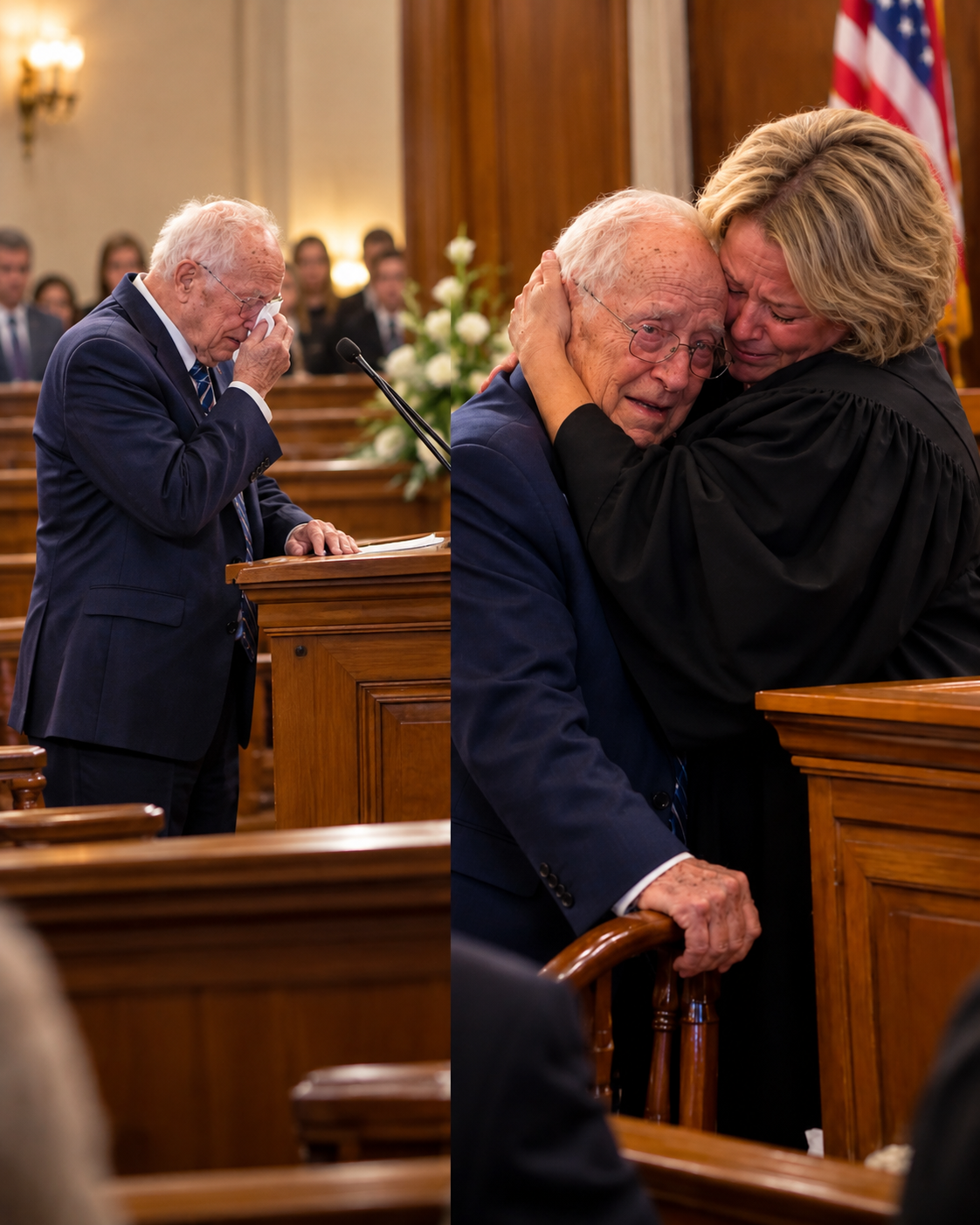
PART1:
My one-hundred-and-one-year-old neighbor was completely prepared to go behind bars for stealing more than two thousand dollars’ worth of essential supplies from our local general market in Mapleton. He stubbornly refused to give any explanation to the bench, even when the presiding magistrate repeatedly pressed him for a motive. Yet I knew the secret he carried in silence, and the harsh reality was far more heartbreaking than anyone sitting in that room could ever imagine.
“Mr. Callahan, do you truly comprehend that you could be sent to an adult correctional facility for these offenses?” Judge Thomas Lawson asked from his elevated bench.
“I understand completely, Your Honor,” the frail man replied while balancing his shaking frame on an old wooden walking stick.
“Then why on earth will you not provide this court with a single explanation for your actions?” the magistrate inquired with a furrowed brow.
Clarence Callahan gripped the polished handle of his cane with both of his weathered hands and kept his chin lowered toward his chest.
“I took those items without paying for them, and I stand before you guilty as charged,” Clarence said in a dry, raspy whisper.
Judge Lawson examined the elderly man through thick wire spectacles, leaning forward over his wooden bench as if searching for something hidden behind the wrinkles.
“At one hundred and one years of age, you ought to be relaxing on a front porch enjoying your retirement years rather than answering criminal charges inside my courtroom,” Judge Lawson pointed out gently.
“I am truly sorry for taking up your time and causing trouble for this town, sir,” Clarence murmured without raising his eyes.
The judge shifted his attention toward several glossy surveillance printouts neatly arranged across the middle of his mahogany desk.
“Baby clothes, canned vegetables, infant diapers, notebooks, and boxes of colored pencils,” Judge Lawson read aloud while tapping a finger against the paper.
He lifted a second photograph that showed the tall, hunched silhouette of the centenarian stepping past the sliding glass exit doors with stuffed canvas bags.
“The shop clerks at the Mapleton General Market let you walk away with simple warnings several times because they respected your advanced age,” the magistrate noted. “Yet you returned repeatedly even after the store manager warned you that corporate policy would force them to file formal police reports, so why did you keep doing it?”
Clarence stood completely motionless beside his public defense counsel, keeping his pale lips pressed into a tight, quiet line.
“You took more than two thousand dollars’ worth of store merchandise over a span of five months,” the judge reminded him firmly. “You certainly realize why the shop owners finally felt compelled to press formal larceny charges against you.”
“Yes, sir, I understand their position perfectly well,” Clarence whispered with a heavy nod of his head.
“Then give me just one valid reason why I should not sign this commitment order and remand you to the county jail right now,” Judge Lawson urged.
Clarence took a shuddering breath that made his thin wool sweater rise and fall against his narrow chest.
“I do not have a single excuse to offer you, Your Honor,” Clarence answered softly as his voice broke slightly in the quiet chamber.
I could no longer remain motionless on the polished wooden spectator bench behind him, so I pushed myself to my feet before fear could talk me out of speaking.
“Yes, he does have a reason, Your Honor!” I called out across the silent courtroom.
Clarence spun his fragile frame around with surprising speed, his milky eyes widening as he looked directly into my face.
“Brenda, please sit back down in your seat and stay out of this,” Clarence pleaded with genuine panic ringing through his frail voice.
I had lived right next door to Clarence along Maple Street for more than three decades, watching him tend his garden through hot summers and bitter winters alike.
Never once in all those thirty years had I seen that proud old gentleman look so utterly terrified of what someone might say.
“Your Honor, this man made me swear on a Bible that I would never repeat what he told me, but I refuse to stand by and watch him get locked in a cell when the court knows nothing about the truth,” I announced clearly.
I reached deep inside my leather purse, pulled out a worn piece of paper folded into four neat squares, and held it up for the bench to see.
“Please let me speak, because there is something essential about this man that you need to hear before passing judgment,” I begged the court.
Judge Lawson raised a hand to silence the bailiff who was moving toward my row, and he waved me toward the front microphone with a solemn nod.
“Step forward to the podium, ma’am, and state your name for the court reporter before you tell me what is on that paper,” Judge Lawson instructed.
“My name is Brenda Holloway, and I have been Mr. Callahan’s immediate neighbor for thirty years,” I said into the microphone.
Clarence shook his head in pure misery, leaning heavily upon his walking stick while muttering quiet objections under his breath.
“You may proceed, Mrs. Holloway, because this court wants to know why a centenarian with a spotless record suddenly turned to shoplifting,” the judge said patiently.
PA
PAER 2:
I turned slightly toward the gallery and extended my hand toward a tired young woman sitting quietly in the very back row with a sleeping little boy resting against her shoulder.
“Her name is Rebecca Foster, and she lives just three houses down from us while raising three small children completely by herself,” I explained to the entire room.
Rebecca lifted her chin in utter bewilderment, shifting her toddler’s weight as her wide green eyes darted from my face to the judge.
“Her former partner walked out on that family two years ago without leaving behind a single dollar of financial support,” I told Judge Lawson. “Rebecca cleans office buildings down on Commercial Avenue every night, yet her earnings barely cover the rent and electric bills, leaving almost nothing left over to feed those growing kids.”
Clarence lowered his head completely and closed his eyes as though he were experiencing physical pain from my disclosure.
“Brenda, I am begging you to stop this right now,” Clarence whispered in a hoarse voice that cracked with emotion.
“Those items Clarence took from the market were never kept inside his own cupboards or closets,” I declared to the magistrate. “Every single can of soup, package of socks, and box of school crayons went straight to Rebecca’s front porch after dark.”
Rebecca froze where she sat, her mouth parting slightly as she stared directly at my face in sheer disbelief.
“What are you saying, Brenda?” Rebecca asked aloud, her voice trembling across the quiet gallery benches.
“For nearly five months, Clarence has been sneaking onto your walkway after dusk to leave boxes of fresh food, infant supplies, and school bags right outside your door,” I told her openly.
Rebecca shook her head back and forth as tears immediately began welling in the corners of her eyes.
“He told me that he was buying every single one of those items with money saved up from his veteran pension,” Rebecca cried out.
“You believed his explanation because he constantly smiled and told you not to worry about an old man spending a few extra dollars on his favorite neighbors,” I answered gently.
Judge Lawson leaned over his paperwork, his expression shifting from formal sternness to deep concern as he addressed the elderly defendant.
“Mr. Callahan, is what your neighbor Mrs. Holloway is telling this court the absolute truth?” Judge Lawson asked.
“Yes, Your Honor, everything she just told you is true,” Clarence confessed as a tear slipped down into the deep lines of his cheek.
“Then why under heaven would you keep this information hidden from the court and voluntarily accept a jail sentence instead of explaining your circumstances?” the judge inquired.
Clarence turned his head slightly toward the back row where Rebecca sat clutching her youngest child.
“That young mother spent nearly six months making sure that I did not starve alone in my bed, so there was no way on earth I would let her stand up in a public courtroom feeling guilty for my crimes,” Clarence stated with absolute conviction.
Rebecca covered her trembling mouth with her free hand, letting out a stifled sob that echoed softly off the wood-paneled walls.
“Your Honor, there is something even deeper that you must understand about this entire situation,” I added, stepping closer to the bench. “Rebecca Foster was helping Clarence long before he ever carried a single grocery bag down our street.”
I carefully unfolded the wrinkled sheet of notebook paper that had rested inside my pocketbook for weeks.
“This is a handwritten letter that Rebecca carried over to Clarence during the coldest week of last January,” I said while showing the blue ink to the bench.
Rebecca recognized the rounded strokes of her own penmanship immediately, and she buried her face against her sleeping boy’s dark curls.
“I would like permission to read what she wrote to him on that afternoon,” I requested from the magistrate.
Judge Lawson nodded his approval without speaking, adjusting his glasses while the courtroom remained entirely silent.
“Dear Mr. Callahan, please stop trying to hand my children twenty-dollar bills whenever I bring over a bowl of soup,” I read aloud. “My little ones feel so much comfort knowing that we are keeping an eye on our dearest neighbor, and we want you to know that you are considered true family under our roof.”
The judge looked slightly puzzled by the timeline and tilted his head toward the elderly veteran.
“So there was an arrangement involving home-cooked meals between your two households?” Judge Lawson asked.
“Rebecca began looking after Clarence when he contracted a severe respiratory infection last winter,” I explained to the court. “Clarence lost his beloved wife Abigail many years ago, and since he has no surviving relatives nearby, he lives entirely on his own without any regular visitors.”
Rebecca had noticed that the heavy floral curtains across Clarence’s front window remained drawn shut for two straight days during an icy blizzard.
When she walked through the deep snow to check on him, she discovered the elderly gentleman shivering beneath two thin blankets, far too weak from fever to boil water or cook a warm meal for himself.
From that chilly afternoon onward, Rebecca brought a hot container of dinner over to his porch nearly every single evening after she returned home from running errands.
She frequently invited him to sit at her family table so he would not have to eat his supper in an empty house, yet Clarence rarely accepted those invitations because he was terrified of being an unnecessary burden on a struggling mother.
Instead, Clarence gratefully accepted the hot containers at his doorway, firmly convinced that she was merely sharing whatever extra portions her household could easily spare.
He thanked her with all his heart for those simple dishes, never once suspecting the immense personal sacrifice that went into preparing them every evening.
Whenever Clarence tried to press crumpled cash into her apron pockets to cover the ingredients, Rebecca politely pushed his hands away and insisted that neighbors look after each other without keeping score.
PART 3:
Then came a chilly evening in late spring when Clarence noticed something that unsettled his conscience deeply.
As Clarence later confessed to me while sitting on my own sofa, Rebecca had brought him a generous portion of roasted chicken, green beans, and mashed potatoes.
When Clarence casually asked her whether she had already eaten her own supper, the young mother offered her usual bright smile and claimed that she had enjoyed a late lunch and felt no hunger whatsoever.
Three nights after that conversation, Rebecca’s eldest daughter Amanda walked across the lawn to deliver another warm container filled with beef stew and warm biscuits.
Clarence knelt down beside the front screen door and gently asked the little girl if her mother had finished her dinner before sending the dish over to his house.
The child looked down at her scuffed sneakers and shook her head, explaining that her mother claimed she was not hungry again because growing children needed the food much more than grown adults did.
“Those warm meals were never extra leftovers from a full refrigerator,” I told Judge Lawson as moisture blurred my vision. “Rebecca was giving up her own evening meals and going to bed on an empty stomach so an elderly neighbor would not starve in his bed.”
I pulled a tissue from my pocket to wipe my eyes while Clarence stood beside his attorney with his shoulders shaking under the weight of his grief.
“When this proud man realized what she was doing for him, he could not close his eyes to sleep at night,” I continued.
“She was depriving her own body of nourishment just to keep breath inside an old man who had already lived past his century mark,” Clarence choked out, unable to contain his sorrow any longer.
Clarence confessed to the court how he had immediately emptied his modest checking balance to buy groceries and baby items for Rebecca’s family, hoping to replenish the pantry she was emptying for his sake.
When his small bank account was completely drained by the steep cost of living, Clarence secretly sold his late father’s gold pocket watch, his military medals, and several heirloom dining chairs to secondhand shops in neighboring towns.
Once every single item of personal value was gone and the cupboards in Rebecca’s kitchen grew bare again, despair drove him to make a terrible choice.
“Every single time my conscience warned me to stop slipping items into my coat at the market, I saw the faces of those three little children starving in that chilly house,” Clarence whispered into the quiet room.
I looked directly at Judge Lawson, determined to finish the entire account before anyone could order me to step down from the stand.
“I discovered his secret when I spotted him struggling to haul heavy shopping sacks down the sidewalk one afternoon, knowing full well his monthly pension check had already been spent on medication,” I said. “He broke down in tears on my porch, confessed that he had been taking food from the store without paying, and begged me to protect Rebecca from ever finding out.”