Five years after abandoning my pregnant girlfriend, I walked into a children’s home with a $3 million donation, only to have a little girl burst through a crowd of reporters, throw her arms around me, and scream, “Daddy! I knew you’d come!”
I had never seen her before, but when I asked about her mother, the staff went silent. Then I learned that the woman I’d abandoned had left something behind for me—something I could only receive if I ever came looking for our daughter.
My name is Michael Rivers, and at thirty-two, I was the kind of man people envied. I owned a Manhattan penthouse, drove cars worth more than most people’s homes, and ran an investment firm occupying twelve floors of a Midtown skyscraper.
But every dollar I’d earned came with a memory I couldn’t escape. Five years earlier, I’d destroyed the only family I might ever have.
I still remembered Claire Bennett standing in our cramped Chicago apartment, clutching a pregnancy test with trembling fingers. Her eyes filled with tears as she whispered, “Michael, we’re having a baby.”
I should have held her, told her we would figure things out together. Instead, terrified of responsibility, I stared at the floor and muttered, “I can’t do this.”
When I eventually reached for my suitcase, Claire grabbed my arm.
“Please, Michael. I’m scared too, but our baby needs you.”
I pulled away.
Within months, I moved to New York for business, burying myself in meetings, investments, and expensive distractions. Whenever guilt surfaced, I convinced myself Claire would call if she needed me, or perhaps she and the baby were better off without me.
Five years passed without a single phone call from me.
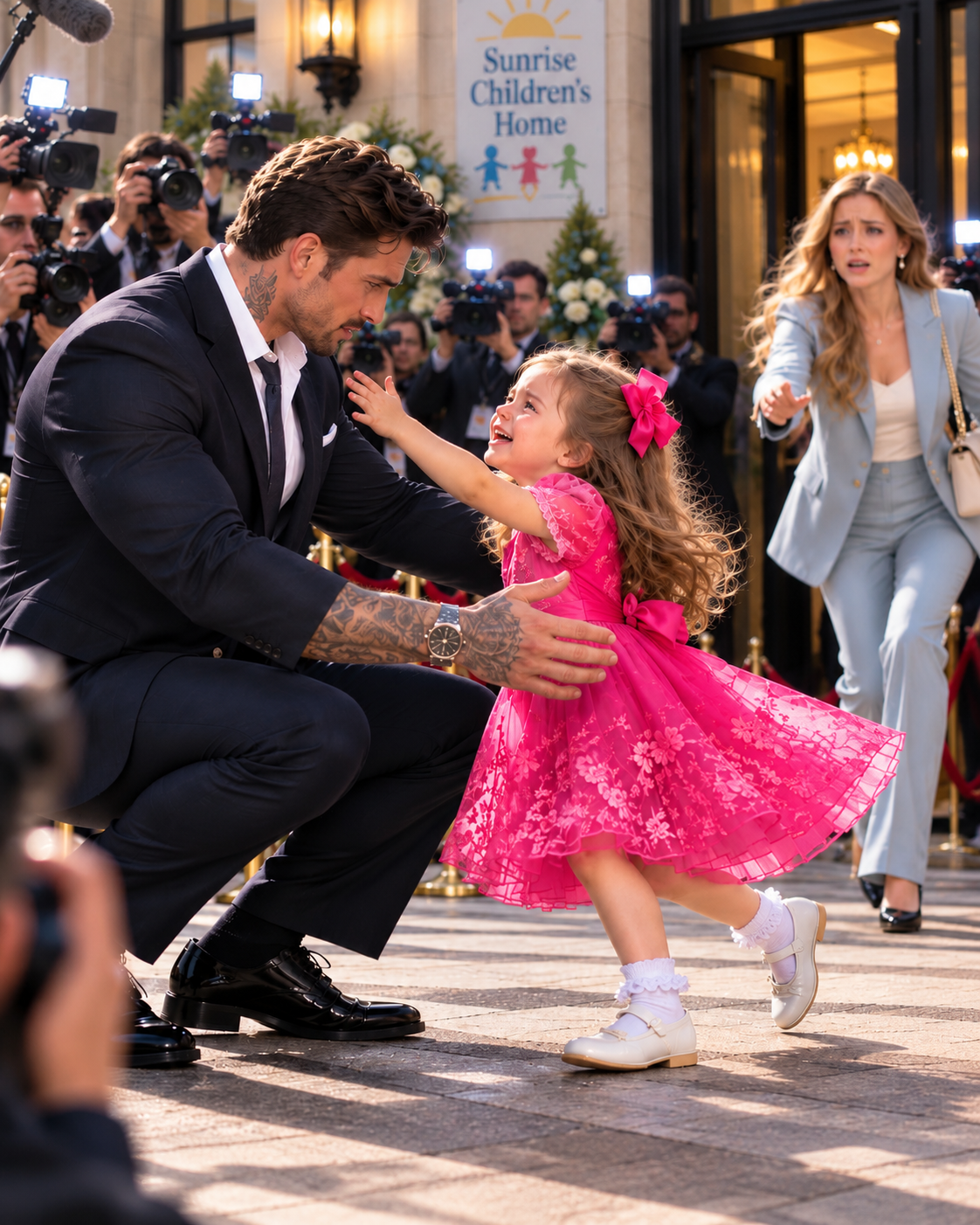
Then my company arranged a $3 million donation to Sunrise Children’s Home. I arrived that morning expecting photographs, a ceremonial check, and another flattering headline.
Reporters surrounded the entrance as cameras flashed in my face. I was answering a question about helping disadvantaged children when a tiny voice suddenly pierced the noise.
“DADDY!”
A little girl wearing a pale mint bow pushed between two reporters and ran straight into my arms. Her brown hair brushed my jacket as she hugged me with a desperation that made my chest tighten.
“I knew you’d come!” she sobbed.
I knelt, completely stunned, and studied her enormous eyes. Something about them was painfully familiar.
“Sweetheart, what’s your name?” I asked.
Her smile disappeared.
“You don’t know me, Daddy?”
Before I could answer, a frightened staff member rushed toward us.
“Mr. Rivers, I’m terribly sorry. Emma saw you on television this morning and slipped away.”
Emma.
The woman stopped speaking when she noticed my expression. I could barely force the words past my lips.
“Is her mother’s name Claire Bennett?”
The color drained from her face.
“Mr. Rivers, perhaps we should speak privately.”
“Where’s Claire?” I demanded, my voice shaking. “Is she here? Is she alive?”
The woman glanced at Emma, then lowered her eyes.
I turned toward the little girl still gripping my jacket.
“Emma, how did you know I was your daddy?”
“Mommy showed me your pictures,” she whispered. “She said you were far away, but maybe one day you’d find me.”
My stomach twisted.
“Where’s Mommy now, sweetheart?”
Emma looked toward the building, her lower lip trembling. Before she could answer, the staff member gently touched my shoulder.
“Mr. Rivers, Claire left something for you. She made us promise we would only give it to you if you came here looking for your daughter.”
I stared at her, struggling to breathe.
“What did she leave?”
The woman wiped a tear from her cheek.
“A letter, and something else. But there’s something you need to know about Claire first.”
I tightened my grip around Emma’s tiny hand.
“Please,” I whispered. “Just tell me where she is.”
The woman opened her mouth, then looked at Emma with such heartbreaking sadness that my knees nearly gave way.
And when she finally spoke, the first words shattered everything I thought I knew.
“Claire is alive,” the staff member said.
For one suspended moment, the words refused to make sense.
I had prepared myself for grief, for a grave, for some irreversible ending that would explain the sorrow in her eyes.
Alive was supposed to be the word that rescued me.
Instead, it struck with the weight of another question.
“Where is she?” I asked.
The staff member glanced toward Emma, who was still holding my hand with both of hers.
“She’s receiving treatment at a hospice several hours from here,” she said. “My name is Margaret. I’m the director of Sunrise.”
She led us away from the crowded entrance and into a small office lined with children’s drawings, old photographs, and shelves filled with donated books.
Behind us, the reporters continued to murmur, but Margaret shut the door, and their voices faded into a distant blur.
Emma climbed into a chair in the hallway, beside the office window.
She held the mint bow in her hair as though she were afraid it might come loose, and that tiny gesture reminded me painfully of Claire.
Claire had always touched her hair when she was nervous.
I had forgotten that until now.
Or perhaps I had remembered and spent five years forcing myself not to.
Margaret sat across from me and folded her hands over a thick envelope.
“This is the letter Claire left for you,” she said.
I stared at it.
My name was written across the front in handwriting I knew instantly.
Michael.
The letters slanted slightly to the right, just as they had on grocery lists, birthday cards, and the notes Claire used to leave beside my coffee when she had to leave for work before I woke.
I reached for the envelope, but stopped before touching it.
“Why was Emma here?” I asked.
Margaret’s expression softened.
“Claire brought her to Sunrise three months ago.”
My throat tightened.
“She gave up her daughter?”
“No,” Margaret said firmly. “She placed Emma here temporarily because she was afraid she might not be able to care for her.”
“That sounds like the same thing.”
“It isn’t.”
Margaret’s voice carried no judgment, only certainty.
“Claire visited whenever her treatment allowed it. She called every evening she could. She read Emma stories over the phone and sent her drawings. She never intended to leave her here forever.”
I looked at Emma through the glass window separating the office from the hallway.
She had found a box of colored pencils and was arranging them by shade.
“She told me Mommy would come back,” Emma said without looking up.
Margaret’s eyes grew wet.
“Claire told her the truth as gently as she could.”
“That she was sick?”
“That she needed help getting well.”
I looked down at the envelope again.
“What happened to make her believe she couldn’t care for Emma?”
Margaret hesitated.
“She became weaker very quickly. The doctors adjusted her medication, but she could no longer manage the stairs in their apartment, and there were days when she couldn’t prepare meals. She was frightened that Emma would see her decline and begin believing it was her responsibility.”
My fingers closed around the envelope.
“Why didn’t she contact me?”
Margaret’s silence answered before her words did.
“Claire believed you had made your choice.”
I flinched.
“She knew where I was. She knew I had a company. She could have found me.”
“She said she tried to protect Emma from becoming another unanswered question.”
I looked toward the hallway.
Emma was drawing something with a green pencil now.
A house, perhaps.
There were three small figures standing in front of it.
One was much taller than the others.
“Did she tell Emma who I was?”
“Yes.”
“Why?”
“Because Claire refused to teach her a lie.”
The words settled heavily between us.
Margaret pushed the envelope toward me.
“Read it when you’re ready.”
FULL STORY – PAGE 2
I broke the seal with a hand that no longer felt like mine.
Inside was a single folded sheet of paper and a small brass key attached to a blue ribbon.
I unfolded the letter.
Michael,
If this has reached you, then you came looking for Emma.
I stopped reading.
The room blurred, and I had to press my thumb against the paper to keep it from shaking.
I came looking for Emma?
I had arrived with a ceremonial check, a schedule, and a camera crew waiting outside.
I had not known she was here until she ran into my arms.
But perhaps Claire understood that one day knowledge would find me, even if I never searched for it.
I forced myself to continue.
I am not writing to ask you for money.
I have never wanted your money.
I am writing because Emma deserves the truth, even if the truth is painful.
She is your daughter.
The words seemed to open a door inside me, and behind it waited every moment I had missed.
Her first cry.
Her first steps.
The first time she called someone Daddy.
The first fever I had not stayed awake through.
The first night she had cried for a father who did not know her name.
I lowered the letter, struggling to breathe.
“You knew?” I asked Margaret.
She nodded.
“Claire told us from the beginning.”
“Why didn’t you tell me when I arrived?”
“She asked us not to.”
“Why?”
“Because she wanted the decision to come from you.”
I looked at her sharply.
“What decision?”
“Whether you would step forward after learning the truth.”
I almost laughed, but there was nothing amusing in the sound that escaped me.
“I’m here.”
“You are here today.”
Margaret’s words were gentle, but they found the exact place where my pride had been hiding.
“You’re right,” I said. “I am.”
I returned to the letter.
Emma is bright, sensitive, and more observant than people realize.
She notices every promise people make, especially the ones they fail to keep.
Please do not tell her you love her unless you are prepared to prove it through ordinary things.
Show up when you say you will.
Listen when she speaks.
Let her be angry without asking her to make you feel better.
Do not make her responsible for forgiving you.
My vision blurred again.
Claire had always understood the things I avoided understanding.
She had known that apologies could become another burden if they were offered only to make the guilty person feel cleansed.
I read on.
I know you may wonder why I never came to New York.
I know you may think I kept Emma from you.
The truth is more complicated than either of us deserves.
For now, I can only tell you that I was afraid, and that fear made me accept help from people who did not understand what they were taking from us.
I did not want Emma raised as an obligation.
I did not want you to return because a letter made you feel guilty.
I wanted you to come because you chose her.
The room fell silent except for the quiet hum of the heating vent.
I read the final lines slowly.
There is something in the box beside this letter.
You gave it to me before you left, though you may not remember.
Keep it only if you are willing to remember the man you were before you became afraid.
Claire
My eyes moved to the small brass key.
“What does this open?”
“A wooden box,” Margaret said. “Claire left it here with the letter.”
She reached beneath her desk and brought out a narrow box made of worn walnut.
It was no larger than a book.
The key fit into the lock.
I hesitated.
Emma had stopped drawing and was watching me through the glass.
“Should she see this?” I asked.
“Claire said the choice was yours.”
I turned the key.
The lock clicked.
Inside lay a small music box with chipped blue paint around its edges.
Beside it was a photograph.
I lifted the photograph first.
For several seconds, I could not understand what I was seeing.
Then the past rose before me with painful clarity.
Claire was sitting on the edge of our bed, her hair pulled loosely over one shoulder.
Her pregnancy had begun to show beneath a soft gray sweater.
I was standing behind her with both hands resting over her stomach.
My cheek was pressed against her hair.
We were smiling.
Not politely.
Not uncertainly.
We were laughing at something outside the frame, and the happiness in my face was so open that I barely recognized myself.
Claire had taken the photograph with an old camera balanced on a stack of books.
I remembered the evening suddenly.
She had been worried that I would resent the baby.
I had pulled her against me and promised that fear did not mean I would leave.
“I’m going to be a good father,” I had told her.
The memory tore through me.
I had believed those words when I said them.
That was the worst part.
I had not been pretending.
I had loved the child before I knew her.
I had loved Claire before fear convinced me that love was a trap.
FULL STORY – PAGE 3
Emma came into the office and stood beside my chair.
“Is that Mommy?”
“Yes.”
“And is that you?”
My voice broke.
“Yes.”
She studied the photograph.
“Were you happy?”
I looked at the man in the picture.
“We were.”
“Why did you go away?”
There was no safe answer.
No explanation that would make a five-year-old understand why an adult had chosen absence over courage.
“I was afraid,” I said.
“Of me?”
“Never of you.”
“Of Mommy?”
“Never of her either.”
“Then what were you afraid of?”
I set the photograph on the desk.
“I was afraid I wouldn’t know how to be a father.”
Emma considered this.
“But you could have learned.”
The simple truth of it left me defenseless.
“Yes,” I whispered. “I could have.”
She looked down at the music box.
“Does it play?”
I wound the tiny metal key beneath its base.
A soft, uneven melody filled the room.
It was an old lullaby Claire used to hum while cooking dinner.
Emma’s expression changed.
“Mommy sings that.”
“She sang it to you?”
“Every night when I was little.”
I listened to the music and remembered Claire standing beside the kitchen window, one hand resting over her stomach while she sang to the baby inside her.
I had been sitting at the table, pretending to read a business report.
She had asked me whether I liked the song.
I had told her it was beautiful.
That memory had been buried beneath so many years of deliberate forgetting that discovering it felt like finding a room in a house I thought I had abandoned.
Emma touched the photograph.
“Can I keep it?”
I looked at Margaret.
“She left it for you,” Margaret said.
I handed it to Emma.
She held it carefully with both hands, as though it were fragile enough to break beneath her fingers.
“Mommy said you used to love me before I was born,” she said.
I swallowed.
“I did.”
“Do you love me now?”
The question was so direct that every polished answer vanished.
I looked into her eyes and saw Claire’s face, my own guilt, and the child who had been waiting for an answer I had never deserved to give.
“Yes,” I said. “I love you now.”
Emma’s eyes remained fixed on mine.
“Will you go away again?”
The music box played its final notes and fell silent.
“No,” I said.
The word came from somewhere deeper than intention.
“I won’t.”
Margaret watched me carefully.
“Promises matter to Emma.”
“I know.”
“Then do not make one unless you understand what it will require.”
“I understand.”
But I didn’t.
Not fully.
I understood that I would have to return tomorrow.
I understood that I would need to learn her routines, her favorite foods, the stories she liked, and the things that frightened her at night.
I understood that love would not be proven by a check or a house or the name on a company building.
I did not yet understand how many times I would have to choose her before she believed I had chosen her at all.
Emma slipped her hand into mine.
“Can I show you my room?”
I looked at Margaret.
“If that’s all right.”
“It is.”
Emma led me down the hallway, moving with the cautious excitement of a child afraid that joy might disappear if she ran too quickly.
Sunrise was an old brick building with bright rugs, scuffed wooden floors, and handmade decorations hanging from every wall.
The place was modest, but it had been cared for with extraordinary tenderness.
Emma’s room held two beds, though the second one was empty.
A row of stuffed animals sat against the wall.
On the shelf above her bed were drawings of houses, families, flowers, and a tall man with dark hair standing beside a little girl.
I recognized myself in every picture.
In one, I was holding her hand.
In another, I was pushing her on a swing.
In the newest drawing, a woman stood on the other side of Emma.
Her hair was yellow because Emma had run out of brown pencil.
“Is that Mommy?” I asked.
Emma nodded.
“I made room for you.”
She pointed to the empty space between them.
I had to turn away for a moment.
On the wall beside her bed hung a calendar.
Several dates were circled in purple.
“What are those?” I asked.
“Days Mommy comes to see me.”
I counted them without meaning to.
There were fewer circles in the recent months.
The gaps between them had grown longer.
“Why didn’t she come last week?”
“She was too tired.”
“And the week before?”
“She was at the hospice.”
Emma said the word as if she had heard it many times but still did not understand what it meant.
“Can we go see her?”
The question came so quietly that I almost missed it.
“Yes,” I said.
“Today?”
I looked at the clock.
The drive would take several hours, and the hospice might not allow visitors without notice.
But the thought of waiting suddenly felt impossible.
“I’ll call first,” I said.
Emma’s face brightened.
“You’ll come with me?”
“Yes.”
“You promise?”
I knelt before her.
“I promise I’ll take you to see your mother.”
She studied my face for a long moment.
Then she wrapped her arms around my neck.
The embrace was smaller than the first one at the entrance, but it carried more trust.
I placed my hands carefully around her back.
For the first time in five years, I held my child.
Do you have an image for this story? Reply YES and upload the image, or reply NO to skip.