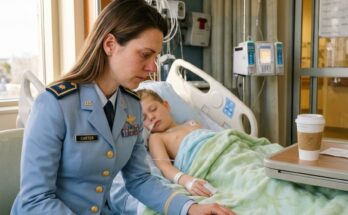
I spent thirty days in the hospital hovering between life and death, and my husband—a surgeon in the very same building—didn’t come to see me even once.
On the day I was discharged, I carefully folded my hospital gown and laid it on the edge of the bed. I had lost thirteen pounds following a ruptured appendix that had spiraled into severe peritonitis.
From the seventeenth-floor window of Metropolitan General Hospital in Chicago, I watched the gray autumn rain slick the pavement while a nurse reviewed my discharge instructions.
“Are you sure no one is coming to drive you home, Clara?” she asked softly, glancing at my chart. “Dr. Marcus Hayes works here, doesn’t he?”
I forced a polite smile and nodded.
“He’s in a procedure.”
Marcus was one of the most celebrated cardiovascular surgeons at the hospital. He worked five floors below my room.
For the first twenty days of my stay, he had been participating in a high-profile international organ transplant initiative that required strict quarantine protocols.
I had spent those three weeks defending him to everyone—my mother, my friends, the nursing staff.
“He can’t leave the unit,” I had repeated like a script. “He’s saving lives.”
Then came the final ten days.
The isolation protocol had ended. I saw photos of Marcus posted on the hospital’s internal network, smiling at a gala dinner with visiting foreign specialists.
Then I saw him in a local news interview.
Then on a stage receiving a clinical excellence award.
Yet, across those ten full days, my hospital room phone never rang.
Not once.
My work as a senior healthcare quality auditor had taught me one fundamental rule: before you react, verify the data.
I opened my tablet, logged into the hospital’s administrative portal, and pulled up the official protocol guidelines for the transplant project.
In less than five minutes, I found Section 4, Paragraph B:
“Personnel in isolation may request a temporary dispensation of up to two hours for immediate family medical emergencies, life-threatening illnesses, or surgical procedures, subject to standard re-sanitization.”
I then queried the system logs for all dispensation requests filed under Dr. Marcus Hayes.
Zero.
Not a single request had ever been submitted.
He had possessed the explicit right to request a visit. He had possessed the means.
He simply chose not to.
And when the quarantine lifted completely, he had ten full days to walk to an elevator, press the button for the seventeenth floor, and walk down the hall.
He chose not to do that, either.
I saved a PDF copy of the protocol, his shift logs, and the public event registries to a cloud drive.
Then I called an Uber.
I didn’t go back to our brownstone in Lincoln Park. I went straight to the law offices of my university friend, Sarah, a family law attorney.
When Sarah saw how frail and gaunt I looked, she stood up so fast her chair scraped against the hardwood.
“Clara! My God, what happened to you?”
“I need you to draft divorce papers,” I said evenly.
She thought I was speaking out of the raw bitterness of illness. So I placed my tablet on her desk and showed her the timeline, the logs, and the protocol documents.
I didn’t want revenge. I didn’t want to strip him of his assets.
We had no children. I proposed an even 50/50 split of the equity in the home we had purchased during our marriage, with each of us retaining our respective bank accounts, vehicles, and personal property.
That afternoon, I went back to the brownstone.
When Marcus saw me, his explanation was a single cold sentence.
“I was too busy.”
I didn’t argue.
I packed my clothes, my degrees, and my books into two suitcases. Then I took off my wedding ring and left it sitting squarely on top of my hospital discharge summary on the dining table.
He still had no idea what I had found in the protocol.
I moved into a furnished, short-term apartment in Gold Coast, changed my phone number, and routed all communication through Sarah.
Two weeks later, while Marcus was enjoying a catered reception in the hospital’s twelfth-floor conference center celebrating the conclusion of his project, a court process server walked into the room holding a manila envelope.
“Dr. Marcus Hayes? Personal service.”
Marcus opened the envelope in front of his colleagues and residents.
Within three seconds, the triumphant smile drained from his face.
It was a petition for dissolution of marriage.
And Marcus had no idea that losing his wife was only the beginning of what was about to unfold.
Later, in Sarah’s office, I stirred my tea as we discussed Marcus’s response.
“And?”
“He says he wants to reconcile.”
That surprised me less than it should have.
Not because Marcus loved me.
Because Marcus hated losing control of a narrative.
For twelve years, Marcus had been exceptionally good at controlling narratives.
At the hospital, he was the brilliant surgeon who worked impossible hours.
At conferences, he was the calm physician who saved difficult cases.
Among our friends, he was the devoted husband whose wife understood the demands of medicine.
And at home, he had always been careful.
Never cruel enough to leave a bruise.
Never careless enough to leave an obvious accusation.
Just distant enough that I was always the one explaining his absence.
“He had a difficult case.”
“He’s exhausted.”
“He’s saving someone’s life.”
I had spent years translating his indifference into excuses.
But the month I nearly died had finally stripped away the excuses.
Sarah leaned back in her chair.
“He asked me whether you had found out something.”
I looked up.
“Found out what?”
“That’s exactly what I asked him.”
“And what did he say?”
“He changed the subject.”
For several seconds, neither of us spoke.
Then I slowly put down my spoon.
“Sarah, I don’t think he knows about the protocol.”
“He might.”
“No.”
I shook my head.
“If he knew I had checked the records, he would have mentioned them. Marcus always explains things when he believes he has evidence on his side.”
Sarah nodded.
“So what do you think he’s afraid of?”
I looked toward the window.
Rain was sliding down the glass in thin, crooked lines.
“I don’t know yet.”
And that was the truth.
I didn’t know what Marcus was afraid of.
But I knew one thing.
A man who had ignored his wife for thirty days while she fought for her life did not suddenly become desperate for reconciliation because he had discovered how much he loved her.
Something had changed.
And I intended to find out what.