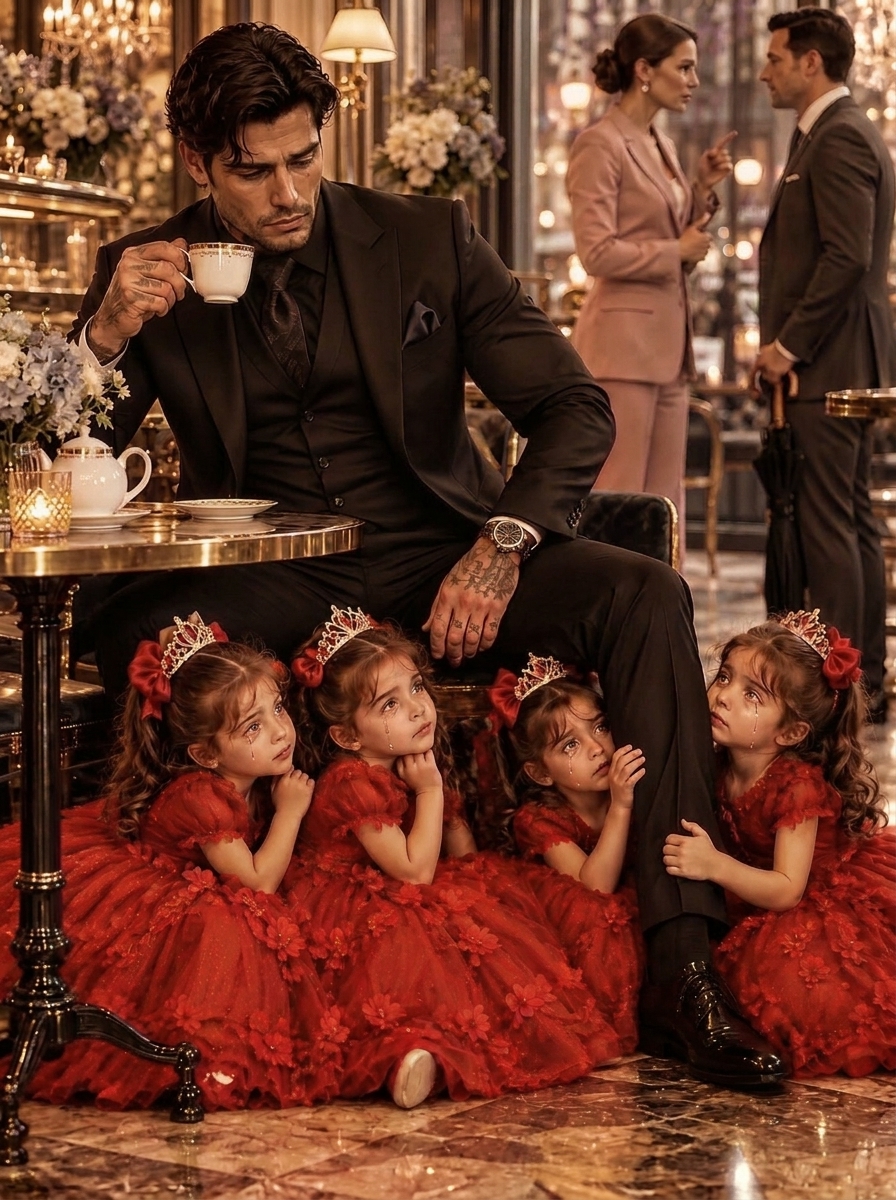
Four terrified little girls crawled beneath my café table in Chicago and begged me to pretend I was their father. A man they desperately feared was searching for them, and the smallest girl clung to my leg as if her life depended on it.
What none of them knew was that they’d chosen Alexander Hayes, a man even Chicago’s most dangerous criminals feared.
The first little face appeared beneath my table so quietly that I nearly missed it. Within seconds, three more girls had squeezed beside her, their matching navy coats and cream-colored ribbons trembling as they huddled together.
My hand stopped halfway to my teacup. One girl looked terrified, another furious, a third was fighting tears, and the smallest gripped my pant leg with both hands.
“Please,” she whispered. “Help us.”
Most people in Chicago knew my name. Behind closed doors, I controlled businesses, territory, information, and men who understood the consequences of betrayal.
Fear was something I’d learned to recognize.
But seeing it in four innocent faces made my stomach tighten.
“Are you lost?” I asked gently.
All four shook their heads. The smallest glanced toward the entrance, where a woman in a charcoal-gray suit stood beside three men.
“That’s our mommy,” she whispered.
I studied the woman carefully. Her dark auburn hair was pinned neatly back, and despite her elegant appearance, her anxious eyes kept searching the crowded café.
“Then you should go back to her.”
“NO!”
Their voices came together so sharply that I immediately lowered my teacup.
The smallest girl looked straight into my eyes.
“Please pretend you’re our daddy.”
For a moment, everything around me seemed to go silent. I’d spent years dealing with ruthless men, dangerous secrets, and people willing to betray anyone for power, but nothing had prepared me for this.
“Why?” I asked.
“Because Mr. Mercer says we need a daddy,” one girl explained.
“But we don’t want him!” another interrupted.
My gaze moved toward the men beside their mother.
“Which one is Mercer?”
The angriest girl pointed toward a sharply dressed man near the doorway.
“Him.”
“What did he do?”
“He told Mommy she’s difficult,” one whispered.
“He said nobody respects women who can’t keep a husband,” another added.
“He says our family is broken.”
Then the smallest girl tightened her fingers around my pants.
“He said he could fix us.”
A cold anger spread through my chest.
“Has he hurt any of you?”
Four heads shook.
“Has he threatened you?”
This time, nobody answered.
Finally, one girl swallowed nervously.
“He told Mommy she’s going to marry him someday. He said we should practice calling him Dad.”
My jaw tightened.
I knew men like Mercer. Men who confused control with love and treated another person’s future as something they could simply claim.
At home, my son Ethan was the only person who saw beyond my reputation. Since losing his mother years earlier, he’d become my reminder that family mattered more than money, territory, or power.
Looking at those girls, I remembered the fear I’d once seen in Ethan’s eyes.
Children didn’t care about powerful names or criminal empires. They cared about who made them feel safe.
And somehow, these four little strangers had chosen me.
I carefully set my teacup down.
“Okay.”
Four pairs of eyes widened.
“Okay what?” the smallest asked.
I glanced toward their mother, then back at the frightened children beneath my table.
“Okay, sweetheart. I’ll pretend to be your father.”
Relief began spreading across her tiny face.
But before she could speak, heavy footsteps approached.
Slow.
Deliberate.
The girls suddenly went rigid.
I raised my eyes toward the approaching figure.
Mr. Mercer was walking straight toward my table.
And judging by the look on his face, he had no intention of asking politely.
Mr. Mercer stopped beside my table.
Up close, he looked less frightening than polished—mid-forties, expensive gray suit, silver watch, and the composed expression of a man accustomed to being welcomed wherever he went. But the girls’ reaction told me more than his appearance ever could.
The smallest pressed herself against my knee.
The other three went silent.
I stood slowly, placing myself between them and the aisle.
“Can I help you?” I asked.
Mercer’s eyes moved over me, measuring my clothes, my watch, the quiet confidence I didn’t need to announce.
Then he smiled.
“I believe those children belong with their mother.”
“They do,” I said. “Their mother is over there.”
His gaze shifted toward the woman in the charcoal suit. She had taken one step forward, but the two men beside her had stopped her with uncertain glances. She looked pale now, and not because of me.
“Girls,” Mercer called pleasantly. “Come out from under the table.”
No one moved.
The smallest girl’s fingers tightened around my pant leg.
Mercer’s smile thinned.
“You’re frightening them,” I said.
“I’m trying to retrieve them.”
“Then perhaps speak to them like children instead of issuing commands.”
Something flickered in his eyes. Irritation, quickly covered.
“I’m not sure who you are,” he said.
“That makes two of us.”
“I’m Marcus Mercer.”
“I heard.”
“And you are?”
“Alexander Hayes.”
The two men behind him exchanged a brief look.
It was almost imperceptible, but Mercer noticed. His face changed by less than an inch.
The café continued around us—cups clinking, a barista calling out an order, someone laughing near the front window—but our corner seemed to draw its own silence.
Mercer’s voice became more careful.
“Mr. Hayes, this is a private family matter.”
“Then it should be handled by the family.”
“I’m advising their mother.”
I looked toward the woman in the charcoal suit.
She closed her eyes for half a second, as though bracing herself.
“My name is Clara Bennett,” she said. Her voice was controlled, but exhaustion rested beneath every word. “The girls are mine.”
Mercer turned toward her.
“Clara, please don’t create another scene.”
“I haven’t created anything.”
“You left the meeting without explanation.”
“Because you brought lawyers to discuss a marriage I never agreed to.”
The café seemed to grow quieter.
Mercer’s jaw tightened.
“That isn’t what happened.”
“It is exactly what happened.”
One of the older girls under the table whispered, “He had papers.”
Clara’s expression shifted.
“Lily,” she said gently, “stay where you are.”
Mercer glanced down.
“Children misunderstand adult conversations.”
“Children understand when adults make them uncomfortable,” I said.
He looked at me again.
The charm was gone now, replaced by something colder—not rage, but calculation.
“I assume you have no idea what you’re involving yourself in.”
“Not yet.”
“Then I suggest you step aside.”
“That suggestion would carry more weight if the children wanted to go with you.”
His mouth tightened.
The smallest girl lifted her face from my knee.
“We don’t.”
Her voice shook, but it was clear.
Mercer leaned slightly forward.
“Sophie, your mother is upset. We’re all going to leave together.”
“No,” Sophie said.
Her sisters moved closer around her.
Clara took another step toward us.
“Girls,” she said softly, “you can come to me.”
They looked at her.
For the first time, I noticed that their fear was not directed only toward Mercer. It was directed toward the entire situation—the watching strangers, the raised voices, the possibility of being separated from the one person they trusted completely.
Clara seemed to realize it too.
She lowered herself into a crouch several feet away.
“I’m not going anywhere,” she said. “You don’t have to hurry.”
The girls remained beneath the table.
That simple patience told me more about Clara than any explanation could have.
She didn’t reach for them.
She didn’t demand obedience.
She waited.
Mercer, however, had no patience for waiting.
“Clara, this is becoming unnecessary.”
“No,” she replied without looking at him. “It became necessary when you told my daughters they needed to practice calling you Dad.”
His face hardened.
“I said it was a possibility.”
“You said it in front of them.”
“I was trying to give them stability.”
“You were trying to make them accept a decision I haven’t made.”
The words were quiet, but they carried.
I glanced at the girls. The one with the furious expression—probably the second oldest—was staring at Mercer with open distrust.
“What exactly is this meeting?” I asked.
Mercer didn’t answer.
Clara did.
“He has been helping with a legal dispute involving my late husband’s company.”
“Helping,” Mercer said. “That is an unfair description.”
“You offered financial support in exchange for control of the trust.”
“I offered a solution.”
“To my children’s inheritance.”
He sighed as if she were being unreasonable.
“Your husband left behind a complicated arrangement. You have no experience managing a company of that size.”
“And you do?”
“I have experience protecting assets.”
“You have experience acquiring them.”
The silence that followed was different.
This time, the discomfort belonged to Mercer.
I studied Clara more closely.
She looked like someone accustomed to being underestimated. Her suit was elegant but practical, her hair neatly pinned, and beneath her eyes were the faint shadows of too many sleepless nights. She didn’t seem weak. She seemed tired of having to prove she wasn’t.
“What company?” I asked.
Mercer’s eyes sharpened.
“That has nothing to do with you.”
“Then stop behaving as if these children do.”
A café employee approached nervously from behind the counter.
“Sir, ma’am, is everything all right?”
Clara rose at once.
“Yes. I’m sorry. We’ll be leaving.”
The girls immediately shook their heads.
“Not with him,” one said.
Clara looked at me.
There was a question in her eyes, though she didn’t ask it aloud.
I understood anyway.
Could she trust me for another minute?
I nodded once.
“Why don’t we move somewhere quieter?” I suggested. “There’s a private room upstairs.”
Mercer gave a short, disbelieving laugh.
“You think you can take Clara and her children upstairs?”
“I think their mother can decide where she goes.”
Clara’s gaze held mine.
Then she turned to Mercer.
“We’re leaving.”
His expression became very still.
“Clara.”
“I said we’re leaving.”
The two men beside him shifted uncertainly. They weren’t bodyguards, I realized. They were attorneys or business associates—men who had followed Mercer because they believed he had authority.
Perhaps for the first time, they were beginning to question it.
Mercer lowered his voice.
“If you walk out now, you’re making this much more difficult.”
“It was difficult before I walked in.”
“I’m trying to help you.”
“You keep saying that.”
“And you keep refusing to listen.”
Clara’s face tightened.
“I listened when you said my husband’s company was too complicated for me. I listened when you suggested the girls needed a father. I listened when you told me no respectable investor would work with a woman in my position.”
Mercer’s eyes narrowed.
“I never said that.”
“You said, ‘People prefer dealing with men who understand business.’”
“Context matters.”
“So does memory.”
Sophie tugged at my sleeve.
“Can we go now?”
I looked down at her.
“Yes.”
I stepped aside, but not far enough to give Mercer access to the girls.
Clara extended her hand toward the table.
“Come on, sweetheart.”
Sophie crawled out first, followed by the others. They stood close together, their small hands linked. The oldest—Lily—kept one hand on Sophie’s shoulder.
Clara reached them and gathered them into her arms.
The children held on tightly.
Mercer watched with an expression I couldn’t read.
Not affection.
Not concern.
Ownership.
That was the word that came to me.
He looked at the girls as if they were part of an arrangement that had already been approved.
I stepped toward the café’s side exit.
“Let’s use this way.”
Clara hesitated.
“I have a car outside.”
“Are you certain it’s safe to leave through the front?”
Her eyes moved toward Mercer.
He smiled faintly.
“Alexander,” he said, using my first name without permission, “you’re making a mistake.”
“Possibly.”
“You don’t know Clara.”
“That’s true.”
“You don’t know what she’s capable of.”
Clara gave a humorless laugh.
“Neither does he. That’s why he hasn’t made up his mind about me.”
Mercer’s attention returned to her.
“You’ll regret turning this into a spectacle.”
“Then stop watching me like one.”
I led the way through the side door into a narrow service hallway. The café manager, a nervous young man named Paul, hurried after us.
“Mr. Hayes, should I call someone?”
“I already have someone coming.”
That wasn’t entirely true, but my driver had been waiting two blocks away. I sent a message as we reached the back entrance.
Clara followed with the girls. She moved carefully, keeping them close without dragging them. Once outside, the cool Chicago air met us, carrying the smell of rain and distant traffic.
The alley opened onto a quieter street.
Clara stopped beneath the awning.
“I owe you an apology,” she said.
“For what?”
“For involving you.”
“You didn’t. Your daughters did.”
The smallest girl looked up at me.
“We had to.”
Something inside my chest loosened unexpectedly.
“Yes,” I said. “I suppose you did.”
Clara glanced at the girls and then back at me.
“You should know Mercer won’t simply forget this.”
“He can remember whatever he likes.”
“He has influence.”
“So do I.”
Her eyes searched my face.
“I know who you are.”
That caught my attention.
Most people who recognized me pretended they hadn’t. Clara didn’t pretend anything.
“How?”
“Your name is difficult to avoid in Chicago.”
“And yet you let your daughters stay with me.”
“They ran to you.”
“Why didn’t you call them back?”
Her expression softened with pain.
“Because I saw the way they looked at you.”
She glanced down at Sophie, who was still holding two fingers of my hand.
“They were frightened. I didn’t want to frighten them more.”
“That’s a good reason.”
“It isn’t the only one.”
I waited.
Clara looked toward the café door, where Mercer’s shadow moved behind the glass.
“Several months ago, my husband died. Since then, I’ve had people telling me what I should do, what I should sign, who I should trust. Mercer arrived with sympathy, then advice, then contracts. I kept thinking if I remained calm and reasonable, he would eventually understand that I wasn’t interested.”
“And he didn’t.”
“No.”
“Why not?”
“Because he believes patience is a form of consent.”
The sentence stayed with me.
My driver pulled to the curb—a dark sedan with tinted windows. The rear door opened.
The girls stared.
“Is that yours?” Clara asked.
“Yes.”
“You’re going to take us somewhere?”
“Somewhere public and safe. You can leave whenever you want.”
She studied me again.
“You don’t even know me.”
“I know you stood outside a café and let your frightened children choose the pace.”
Her eyes glistened, but she quickly looked away.
The girls climbed into the back seat. Lily helped Sophie with the belt. The third girl, whose name I learned was Nora, kept glancing between me and Clara as if waiting for someone to change their mind.
Clara entered last.
I sat opposite them rather than beside Clara. Sophie immediately leaned against the center armrest until her shoulder touched my sleeve.
The driver pulled away.